Sunday, June 9, 2013

An introduction to organic agriculture


Agriculture in the United States and other parts of the world became heavily industrialized during the 20th century.   Some farmers and other conscious individuals formed movements in resistance to what they saw happening because of industrial agriculture.  Perhaps the most famous one is the organic movement.

Dancing Bear Farm is an organic farm.  There is a lot of confusion over the term “organic”, and rightly so because it can mean a lot of different things.  I studied organic agriculture in a number of college classes and thought I had a good understanding of what the term meant and how complicated it was, but it was not until I started interning on certified organic farms that the certification benefits and challenges were really driven home for me.  I am still learning.

Since 2002, the word “organic” has been a certification regulated by the USDA.  In order for a farm to be certified organic, it must follow some basic rules: no synthetic fertilizers or pesticides, no genetically modified seeds, and no antibiotics.  After keeping detailed records, passing a yearly inspection by a third party organization (DBF, for example, is certified by Oregon Tilth), and paying a certification fee, a farm can use the organic label.

While the basics of the organic certification are vital to keeping people and the planet as healthy as possible, many proponents of sustainable agriculture think the current organic regulations leave many important factors out.  Organic regulations dictate little about fossil fuel use, animal welfare, or farmworker treatment, which some say were part of the original ideals of the organic movement before it became federally regulated.  Under organic regulations, a farm can still grow in monocultures and substitute synthetic fertilizers and pesticides with organic ones that are approved for use on the National List.  After harvest, they can still ship it across the country and sell it in stores like Wal-Mart, which care little about anything other than profit.

While some organic farms look similar to conventional farms, thousands and thousands of certified organic farms do not.  These farmers are not simply concerned with following the certification rules; they want to farm in a sustainable way that builds the fertility of the land, produces healthy food, and is an enjoyable living.  Most of these farms are very small because it takes a lot more human effort to farm sustainably.  Other methods of fertility and pest control must be utilized such as planting in polycultures, using flowering plants to attract beneficial insects, growing cover crops, mulching, integrating animals into the farm, and of course weeding by hand.

DBF has a variety of flowering plants that attract beneficial insects.

DBF's chickens and ducks eat insect pests,
provide fertility, and make tasty eggs.

Certified organic produce is a good start to making sustainable agriculture more mainstream, but you shouldn’t assume anything with the organic label is 100% wholesome.  There are a number of venues to find delicious, sustainably grown produce: at the farmers market, through a CSA, or at a food cooperative, you will likely find some organic farms represented.  There will also be some farms that use organic and sustainable practices but are not certified organic.  The two main reasons I have heard for forgoing the certification process is that it is very costly (both in terms of time and money) and that the farm’s customers do not care that they have the certification.  Thus, it is really best to simply ask the farmer about their practices.  Unfortunately, often only people with the resources (time, money, and knowledge) can participate in this alternative agriculture movement, but with time I think it is becoming more accessible to a wider group of people.  It must become so in order to be a viable resistance to industrial agriculture.

Such an abundant variety of produce can be grown organically on six acres.
(I'm told to wait until August when we're swimming in summer veggies.)

Sunday, June 2, 2013

New on the farm: two weeks in photos

The new intern, wearing good farmer clothing:


Weeding is one of our main activities.  No Round-Up here (DBF is certified organic):

The first few days we spent weeding onions.

before

after

Harvest days are currently on Fridays for market on Saturday:

three varieties of carrots

duck eggs

fresh Maitake garlic

peas

One intern and Steve go to the Grower's Market in Grants Pass on Saturdays:

This weekend's stand was packed with veggies, plant starts, and seeds.

mustard greens, peas, scapes, and garlic

Farm friends:

Joy and Romeo

Wylie (there is another farm dog, Bea, who is also lovely)

chickens and ducks (they like the tractor)


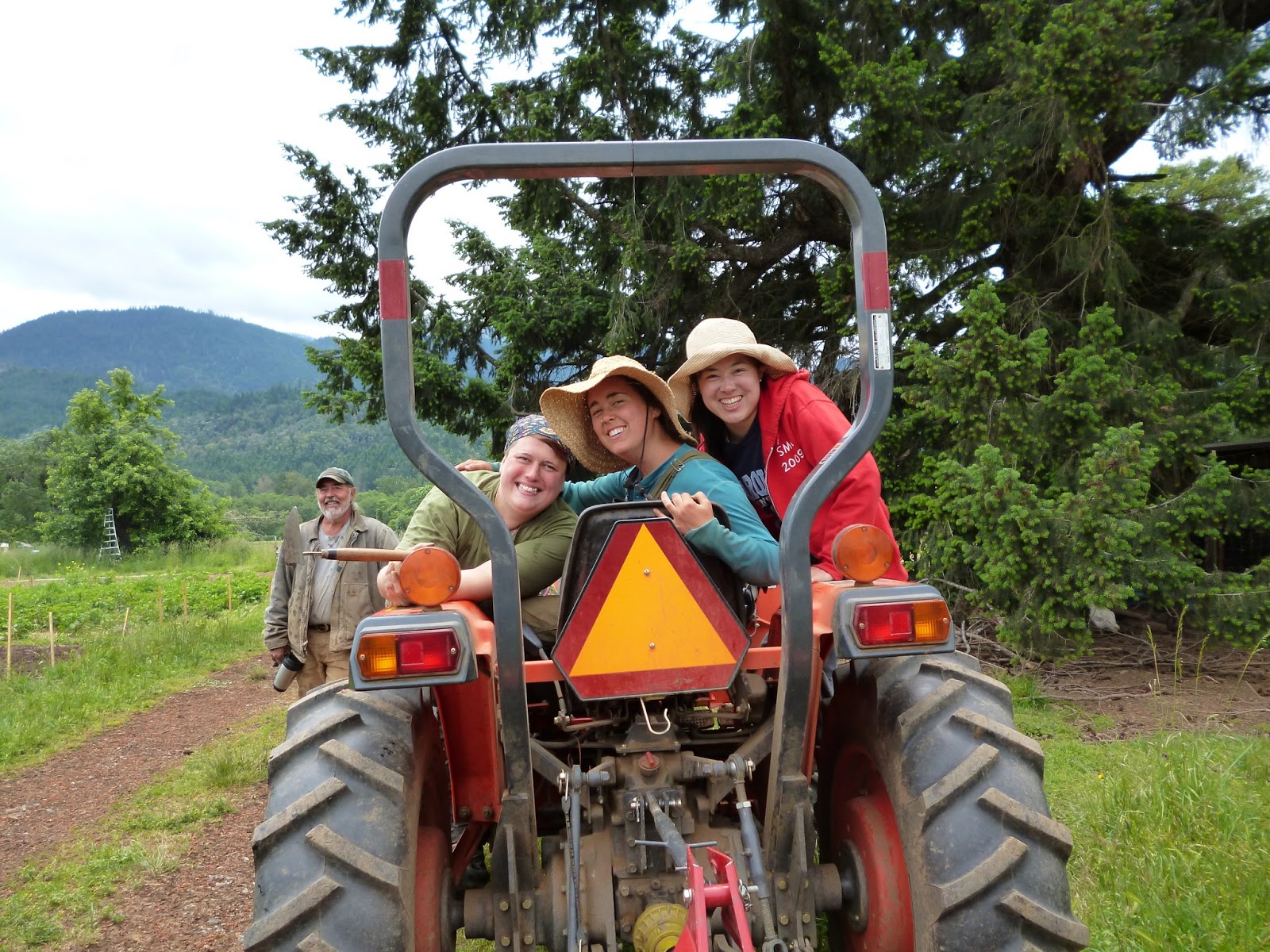
The DBF team

L to R: Steve, Piper, Leda, Erika (plus photographer/farm mom Patricia)
A post with more photos is on its way soon (I have had very little internet since my arrival).  Apologies for the delay!


Monday, May 20, 2013

Arrival in the Williams Valley


Can you spot the chicken running away?

Intern house

Greetings from the Williams Valley in southern Oregon!  I arrived for my five month internship with Dancing Bear Farm on Saturday and my first full day of work is tomorrow. 

So far I’ve been busy settling in to my new home base.  On Saturday I went with Steve to Ashland for some super fun contra dancing.  Yesterday the Farm Corps had a really neat social forestry and natural building class at White Oak Farm (hopefully a post on them later) and then I got to pick (and eat!) some delicious strawberries from our little patch on the farm.  Today I hope to weed the intern herb garden and keep looking through our cookbooks for some neat recipe and food preservation ideas.

I moved back to Oregon from Ohio less than a week ago and it seems like I’ve skipped spring and gone straight into summer.  The weather is fantastic right now, although it’s supposed to dry up and get really hot eventually. 

I don’t have a specific topic for this post, but here’s a list of initial observations:
  • I’m going to be doing a lot of weeding.
  • The landscape of southern Oregon is so different from Portland or Wooster.  It really is amazing to be here in person (a photo doesn’t do it justice).  We’re surrounded by mountains, there are tons of farms, and everything is green.
  • I’m looking forward to tapping into the local herb farms, milk stands, and farmers markets.  Many farms host interns and I hope to meet lots of people interested in learning more about sustainable agriculture and living.  There’s definitely a lot going on here.
  • I have never seen so many deer in my life (the only deer I saw in Ohio were dead- roadkill).
  • Duck eggs and chevre are delicious.

DBF duck eggs and Mama Terra goat cheese

Freshly picked strawberries and greens for intern sustenance

I'll try to keep regular posts up (with photos) despite limited internet access.

Thanks for reading,
ET


Friday, April 19, 2013

Researching Urban Agriculture in Cleveland

Some of you may know that The College of Wooster has a Senior Independent Study (IS), the equivalent of a senior thesis.  I have been working on my IS since the start of my junior year and am almost done.  I have completed my written thesis and passed my orals, so what is left is my Symposium presentation.  Some people have been interested to know what I studied, so here is a bit more information.

A bit about my IS

I wanted to study urban agriculture in Cleveland, Ohio after working there for a summer with a large educational urban farm program.  I really loved the work, but was intrigued by a number of things I saw while working.  I wanted to see the scope and depth of efforts to grow food in the city, and I wanted to see what goals it was achieving.

An urban farm I helped build in 2010
Growing greens in a high tunnel at Buckeye in July 2012

What is really interesting about Cleveland is that unlike many cities, it has urban agriculture zoning laws and a relatively supportive city government.  (Maybe it is because they have 20,000 vacant lots which is expensive to maintain.)  The city has partnered with local community development organizations and other governmental agencies to fund start-up greening projects, many of which are urban gardens and farms.  Many of the projects in my study were funded through ReImagining Cleveland, one such funding source.


These signs denote projects funded by ReImagining Cleveland

I used a sustainable development framework which I developed using a combination of scholars from many disciplines to evaluate urban agriculture in Cleveland.  The point was to create a framework that not just included environmental goals but also justice and grassroots procedures.  I wanted to develop this framework because I found all of these components to be important to the gardeners and farmers I interviewed in my study.  Issues of food justice, race, and inclusive neighborhood development were especially prominent.

I would really like to thank all of the people who participated in my study.  I was able to do 21 really neat interviews of people who are running urban agriculture projects throughout the city.  These individuals are of all ages and all walks of life, and are involved in a wide variety of projects: community gardens, market farms, school gardens, orchards, vineyards, permaculture, and more!  The interview component was my favorite part of my thesis, and it makes me think about doing more formal oral history projects in the future.


Kale in Ohio City

Chickens and permaculture in Ohio City


Summer greenhouse squash in St. Clair-Superior

Heirloom tomatoes in EcoVillage

A field trip to Rid-All

Separate from my IS requirements, as part of my participation in a Food Systems course this semester, I was asked to construct a short unit on food justice which included discussing urban agriculture.  It was a challenge to figure out how to teach and talk about urban agriculture.  (People often put it on a pedestal as the silver bullet to any city’s ills; while I do think urban agriculture has many wonderful benefits, I also do believe that it has drawbacks and that it not always set up to benefit the community where it is located.)  What I decided to do what have an in-class component where we discussed urban agriculture, but then invite students to visit some urban agriculture projects in Cleveland and see for themselves what growing food in the city looks like.


Rid-All's show greenhouse for aquaponics & vermicompost

One of the farms we visited on the field trip was Rid-All Green Partnership - a project that was not in my thesis but that I had been eager to visit for quite some time.  Rid-All is Growing Power’s regional training center in Cleveland (see this post about my visit to Growing Power in Milwaukee).  They run the same educational programming that Growing Power does to build community food systems in all types of contexts.


Co-founder Damien Forshe shows us the aquaponics system

Watercress uses & filters fish tank wastewater

Tilapia live in fish tanks and use recycled water from watercress


I was very impressed to see the amount of work that the three Rid-All founders had done in such a short amount of time: their first greenhouse went up just over two years ago and they now have half a dozen of them.  Not only are they growing produce and fish for a wide range of people in the city, they are building the foundations for other people to grow their own food by serving as an educational organization.  Their combination of business practices and mission of food, social, and economic justice gave me hope that urban agriculture can be a form of sustainable development.


Early spring greens in the greenhouse

Co-founder Keymah Durden explains greenhouse production

Wooster’s Senior IS Symposium

If you’re in Wooster, you can come learn more about my IS research at our Symposium on Friday April 26th at 9:30am in Lean Lecture Hall.  More details and a program (with all student presentations listed) can be found here.

Wednesday, April 10, 2013

A hello from Dancing Bear Farm

My two fellow interns and Steve are already busy at Dancing Bear Farm- the next season of organic vegetable, fruit, and seed production has begun!  I asked Leda (one of the interns) to write brief intro post- thanks Leda!  Stay tuned for more updates, I start work with DBF and Rogue Farm Corps on May 19th.

P.S. Make sure to "like" DBF's facebook page.  There are some great updates and photos there.

Hello! My name is Leda. I’ve been enjoying my month here digging in the dirt and learning at Dancing Bear Farm. I’m very happy to be part of the Rogue Farm Corps. We just had our first potluck get together where we met the other farmers and interns and directors and I feel so grateful to have found this program.  I grew up in a couple parts of Oregon and am happy to explore this region this season. I enjoy being outside, making music, most things related to food, and oooh so much more.

Early growing season at DBF
Since I have been at Dancing Bear we have seeded  many plants, transplanted, practiced unwanted plant control (weeded), sold produce at the Grant’s Pass Market, set up irrigation systems, and enjoyed the beautiful days in the Williams Valley.  I have learned a lot so far and am looking forward to learning from Steve as well as the other farms in the area.