Monday, April 20, 2015

Los Angeles & Food Justice


Last month I participated in one of the UO Holden Center’s Alternative Break trips to Los Angeles. 


The theme of this trip was food justice!  We spent the week meeting with local organizations who are working to make a better food system in Los Angeles, in particular in the South LA (also known as South Central) area.  Here are some of the groups we met, places we visited, and things we learned about along the way.

Some photo credits to Maggie Abney - thanks for sharing.

LA Green Grounds
LA Green Grounds was our wonderful host for the week.  LA Green Grounds is an entirely volunteer-run organization that works to “change turf into edible gardens in South Los Angeles.”  In particular, LAGG focuses on creating edible landscapes in areas that have limited access to fresh, affordable, and local food (you can see a map of where they have worked here).  They also advocate for policies in South LA that support the health of its people and the environment.

We participated in one of LAGG’s “Dig In” sessions at St. Mark’s Lutheran Church, across the street from University of Southern California.  We turned the soil over, added compost and fertilizer, and planted a variety of edible plants.  For many participants on our trip, this was their first time gardening, and they enjoyed learning the basics of gardening.  We also enjoyed meeting and talking with other LAGG volunteers.


Farmers Markets
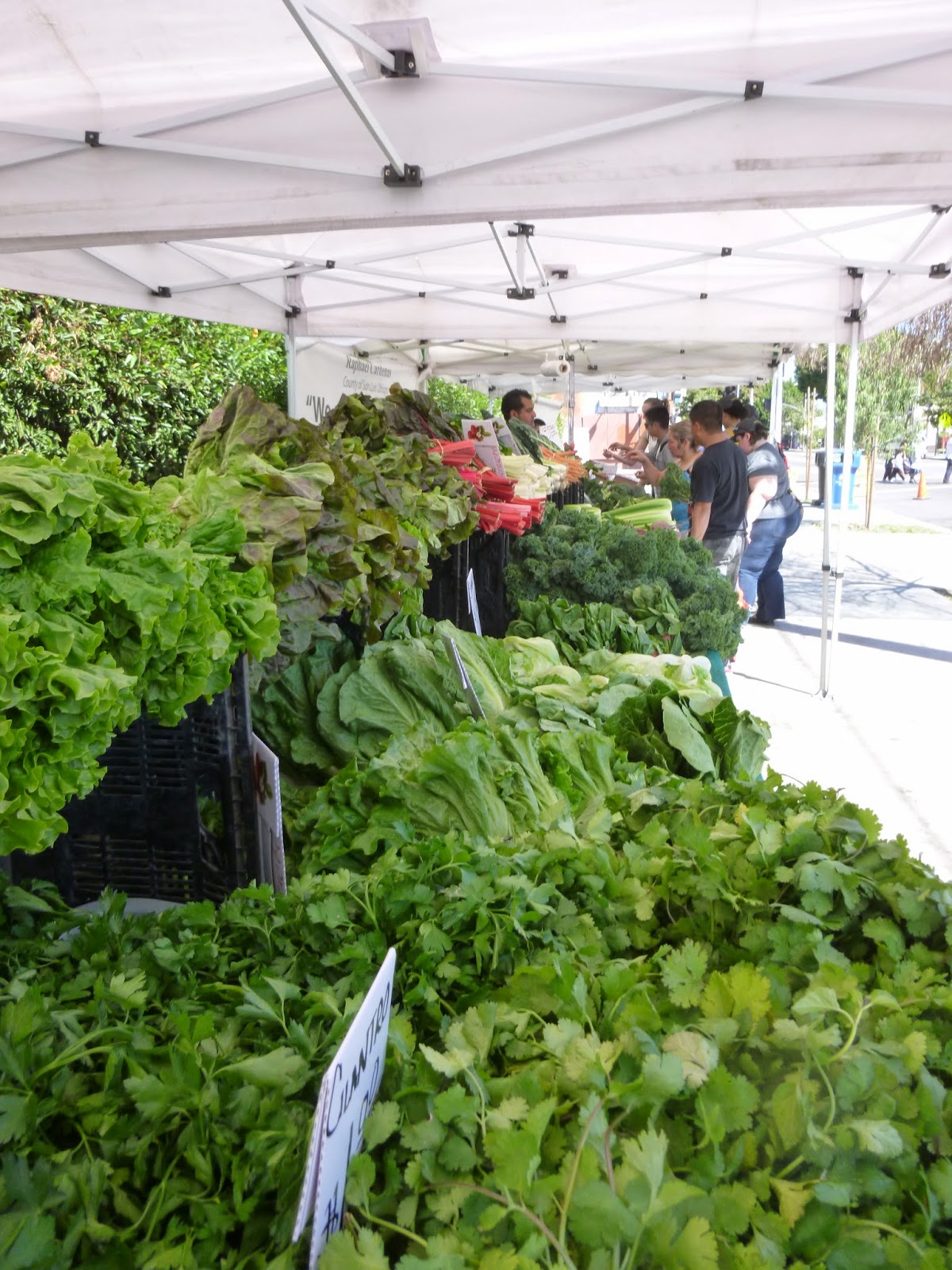
Farmers markets are one way for customers to purchase farm-direct produce.  However, as I’ve discussed in many posts on this blog, there are many potential barriers to farmers markets.  One large barrier is that farmers market produce often costs substantially more than produce at the grocery store, which is why markets have developed a variety of programs that provide extra funds for individuals and families to buy fruits and vegetables at the market.

One of the markets we visited was the Central Avenue Farmers Market, a market whose customer base is primarily Latina women.  This market is operated by the Sustainable Economic Enterprises of Los Angeles (SEE-LA), which offers a Market Match program for SNAP and WIC customers.  This was a small but thriving market with consistent customers and good sales for vendors.


Community Gardens
We visited 3 different community gardens on our trip. 

Glazer Community Garden is overseen by Los Angeles Neighborhood Land Trust, a nonprofit that works to create parks and gardens in areas that lack access to green space.  We had an interesting conversation about how LANLT prioritizes who gets garden plot access (Neighbors? Those in walking distance? People without home garden space? Low-income?), something that is currently being decided on for this particular garden because it is located in a gentrifying neighborhood.


We also visited Ocean View Community Garden, a 6.5 acre nonprofit garden in West LA (which tends to be the more affluent and predominantly white part of LA).  This garden has a 6 year waiting list – an indication that LA needs a lot more community garden spaces. 


The last community garden we visited was Solano Canyon Community Garden, located on a 5 acre slope of land near the LA Dodgers Stadium.  This garden hopes to be a place for at-risk individuals to learn to grow food. 


School Gardens
We visited gardens at Larchmont Charter Schools and 24th Street Elementary School.  Both gardens focus on youth gardening education, cooking, and integrating gardening concepts into core curriculum.  Both of these gardens are managed by nonprofit organizations.  The Edible Schoolyard, known for its original site in Berkeley (co-founded by chef Alice Waters) staffs the garden at Larchmont.  The Garden School Foundation manages the garden at 24th Street Elementary School in addition to 5 other gardens at Title I schools in LA.


Health & Wellness
We sat in on two classes taught by Black Women for Wellness, an organization “committed to healing, educating, and supporting Black Women” and that truly fits its name.  We visited a class that focused on healthful food preparation that was part of the Kitchen Divas and National Diabetes Prevention programs.  We also visited an Urban Chefs Academy class at Crenshaw High School.  These classes were a lot of fun.  We got to speak with class participants and share delicious food.  I appreciated how food was looked at holistically and it wasn’t simply being reduced to nutrition.  


Community Organizing
South Los Angeles neighborhoods have historically been communities of color, due to policies and projects of systematic racism (some discussed on our trip were racial covenants, internment, and incarceration).  However, more recently, due in part to the affordability of housing in the area compared to other parts of LA, more white residents are moving in.  Many South LA neighborhoods are organizing to resist gentrification and maintain control over their communities.

One such neighborhood we visited was Leimert Park, a historic black community.  This community was once a thriving black arts district, but due to crack cocaine and the mass incarceration of people of color, a lot of the local arts culture suffered.  We learned about local arts organizations including the Kaos Network and LA Commons and the work of black business and land owners in revitalizing the local arts.  We also learned about plans to install experimental edible garden space in the neighborhood’s People’s Street Plaza.  All of these community organizing tactics are powerful ways to maintain or reclaim a connection to place as well as resist structural racist policies.


Policy
Lastly, changing unjust policies is one important tactic to building food justice.  We visited Community Health Councils, a nonprofit whose mission is “to promote social justice and achieve equity in community and environmental resources to improve the health of underserved populations.”  They work on policy in LA, especially in South LA, that focuses on environmental health, healthcare, and food access.  Some of their achievements include strong regulations on local oil drilling, funds for grocery store development in South LA (which lacks access to full-service grocery stores), and regulations over new fast food restaurants.  Like Black Women for Wellness, I appreciated CHC’s holistic approach to health and its understanding of how structural policies affect individual health.

***************


This trip only re-affirmed my belief that food justice issues cannot be separated from other social justice issues because of the structural inequalities that are the root causes of them all.  But, this trip also re-affirmed my belief that we all have power in building a more just and sustainable food system for everyone.

A big thanks to Steven Meeks and Florence Nashida of LAGG for organizing the trip and helping us along.  I really valued learning from two people who are leading a multicultural food justice organization in the neighborhoods where they grew up.  Thank you for sharing your knowledge with us.  Keep on growing!

Tuesday, December 30, 2014

Learning to grow food


Spinach! (photo by Meaghin Kennedy of These Salty Oats)

Beets!

Basil!

As 2014 comes to a close, I’m already planning for how I can use my 2015 summer break for agricultural work.  I’m eager to keep learning and continue practicing the agricultural skills that I’ve gained in the past five years.  However, I also wanted to step back and take a moment to acknowledge what a year 2014 was for growing food!  I’m happy with small successes and I learned a lot in 2014 about how I want to grow food in the future.

So, here’s some reflections and photos to share with you about learning to grow food in 2014 in the life of Erika.  (FYI - There are lots of photos.  Remember that you can simply click on the photo to view it in a larger size.)

In the early spring, I co-taught a Seed to Supper class at the Oregon Food Bank.  Seed to Supper is a program of both the Oregon Food Bank and Oregon State University Extension, and is essentially a 5-week basic gardening course for adults who are on a limited budget.  Topics include picking a garden site, soil health, seeds, planting, pest management, watering, and harvesting.

I had a lot of fun teaching this class!  I was able to review basic agricultural concepts and apply them to a home garden setting.  It was also great to be with an enthusiastic group of people (OFB staff, fellow volunteers, and class participants) who had a variety of gardening experiences and expertise to share with the class.  On our last day of class, we took a field trip to one of the Oregon Food Bank’s Learning Gardens, which is the companion program to Seed to Supper.  The Learning Gardens allow for volunteers and students to help produce food near OFB’s two distribution centers in Portland.  The gardens serve as a demonstration site for gardening education and they produce lots of fresh produce that is donated to OFB.  It was cool to see how this program is able to do so much with a small amount of land.  

Garlic at OFB's Learning Garden

Lettuce at OFB's Learning Garden

 Also in the early spring, I was eagerly planning my own home garden as I knew I would be around for the majority of the growing season.  My family and I installed more raised beds in our backyard and built a chicken-proof fence.  For the first time I successfully grew some of my own plant starts and eventually planted them outdoors when it became warm enough. 

Tomato starts that I grew from seed

Spring plantings in backyard

When I began working for Mercy Corps NW Refuge Gardens (link to previous post), I transitioned some of my focus away from the home garden and more to the programs’ garden sites.  In the early spring in SE Portland, we spent time waiting for the ground to dry out and warm up due to some heavy rain spells.  When things started drying up and warming up, we built our 200-foot-long raised beds by hand, untangled a lot of drip tape, and transplanted or direct seeded a variety of crops.  Eventually, we had enough product to go to market and begin selling so that the families participating in the project could start making some money. 

Early season plantings & weeding at Sherrett garden

Early season braising mix

Market!

Early and mid-summer were a lot of fun at work.  While I some spent time helping families with field work and with the succession plantings (more raised beds!), I spent a lot of time focused on harvest and post-harvest handling, helping our produce look pretty and stay fresh for the farmers market.  At the start of every harvest day, I would walk the two garden sites and see what product was ready for picking that day, what would be ready soon, and what needed some attention (aka, weeding).  That got rather interesting when I was trying to evaluate a crop that I had never grown before, but with the help of phone calls to the program director (who worked at our larger growing site) and speaking with the families, we usually figured it out.  Also in mid-summer, I got to visit the Damascus farm site to take some photos, and it was amazing how much was growing out there compared to when I saw it in April.

Lok building raised beds

Jumuna and Guman harvesting spinach

Lok direct seeding summer plantings

Working in packing shed (photo by Meaghin Kennedy of These Salty Oats)

Packing CSA boxes

Transplanting at the Damascus farm site

At home, the biggest struggles I had mid-season were related to watering and rodents.  I was learning about home-scale drip irrigation, then got really lazy and didn’t finish installing irrigation to all of the beds, and was haphazardly watering some things by hand.  Eventually I got drip irrigation for all of the raised crops, but next time I’ll be smart at the start of the season and have the irrigation ready to go earlier.  And then there were the rats, which seem to enjoy eating garden vegetables.  I’d never dealt with a rat problem before, so I didn’t really know what to do.  We removed a large wood pile in the yard (where evidently they had shelter) and our cat went to work.  While the rodent problem was never entirely solved, it certainly seems better now than it did during the summer.

Montesino grape tomatoes (saved from the rats)

Spending time watering in the backyard

There always seems to be a tipping point during the season (I’d say mid-to-late summer) when things just grow like crazy.  After so many months of waiting and hoping and thinking that you as the farmer/gardener are doing things to make a difference, the plants just take off and you realize that you really only have so much control (and understanding) in the whole process of growing a plan.  At work, we had more product than we knew what to do with (especially cucumbers and sungold tomatoes), and I was eagerly buying up bumper crops of various items to preserve at home for the wintertime.  At home, despite my peak season neglect, most plants were vigorously growing.  (And, if it weren’t for our rodent problem, I would’ve been able to eat a lot of those things.  Instead I think I mostly just fed a lot of rats.) 

At home...

Richmond Green Apple cucumber, from Dancing Bear Farm seed

Front yard mania

Green zebra tomato

We planted a dozen new dahlia plants this year.

At work...

Sherrett garden in August

Cippolini onions

Sungold tomatoes

Italian sweet candy roaster peppers

Beans!

Dragon carrots

PSU market madness

Sungolds & shishito peppers

Onions, eggplant, peppers, black radishes, shallots, cauliflower

Chioggia, Touchstone Gold, and Detroit Red beets

September CSA box

At peak harvest time, I moved.  I spent my 23rd birthday carrying furniture and boxes into an apartment in Eugene and started my graduate program two days later.  I was looking forward to spending more time with Andrew and to another adventure, but I really wasn’t ready to leave all of the food I had been trying so hard to grow.  Moreover, I had met so many wonderful people and families in the Portland-area food production community and was sad to leave them.  Nonetheless, I left my work and gardens feeling very optimistic about my future in sustainable agriculture.  Hopefully, my graduate program can give me some more tools for how to combine my agricultural skills with social justice and community organizing.

Lok harvesting pink radishes during my last week of work

Laxmann harvesting black radishes

Since moving to Eugene, I haven’t had the chance to do much gardening or farming.  I have a small community garden plot where I planted garlic and some windowsill herb plants that I propagated from home.  I attended the Beginning Farmers and Ranchers Convivium in October.  I also visited a friend who lives at Berggren Demonstration Farm  (a Rogue Farm Corps host farm!) and helped with her animal chores a couple of times, and attended Food for Lane County’s GrassRoots Garden’s annual Carrot Harvest Day.  On campus, I work for the Student Sustainability Coalition and am working with some other students and campus initiatives to coordinate food justice activities for 2015.  So, while I’m not getting my boots or hands in the dirt much, at least I’m working on other useful skills.

Grove campus community garden

Turkeys at Berggren

Fall chard at Berggren

Spending all my money at the farmers market in late fall

I’m in Portland now for winter break, eating lots of onions, squash, cabbage, and stone fruit.  The home garden looks at lot different now that it did just a few months ago.  We have some herbs and hardy greens still hanging in there, although I did let the chickens eat a lot of what was in the backyard (or maybe that was the aphids).

The garden after the first frost

Lacinato kale in December

Chickens in action, despite the frosty weather

I’m sure by the end of the school year (or before then if I have a chance) I’ll be ready to spend a good chunk of time outdoors in the dirt!  Happy New Year!