Thursday, June 28, 2012

Farm Visits and Market Show Signs of Summer

Farm Visit Updates
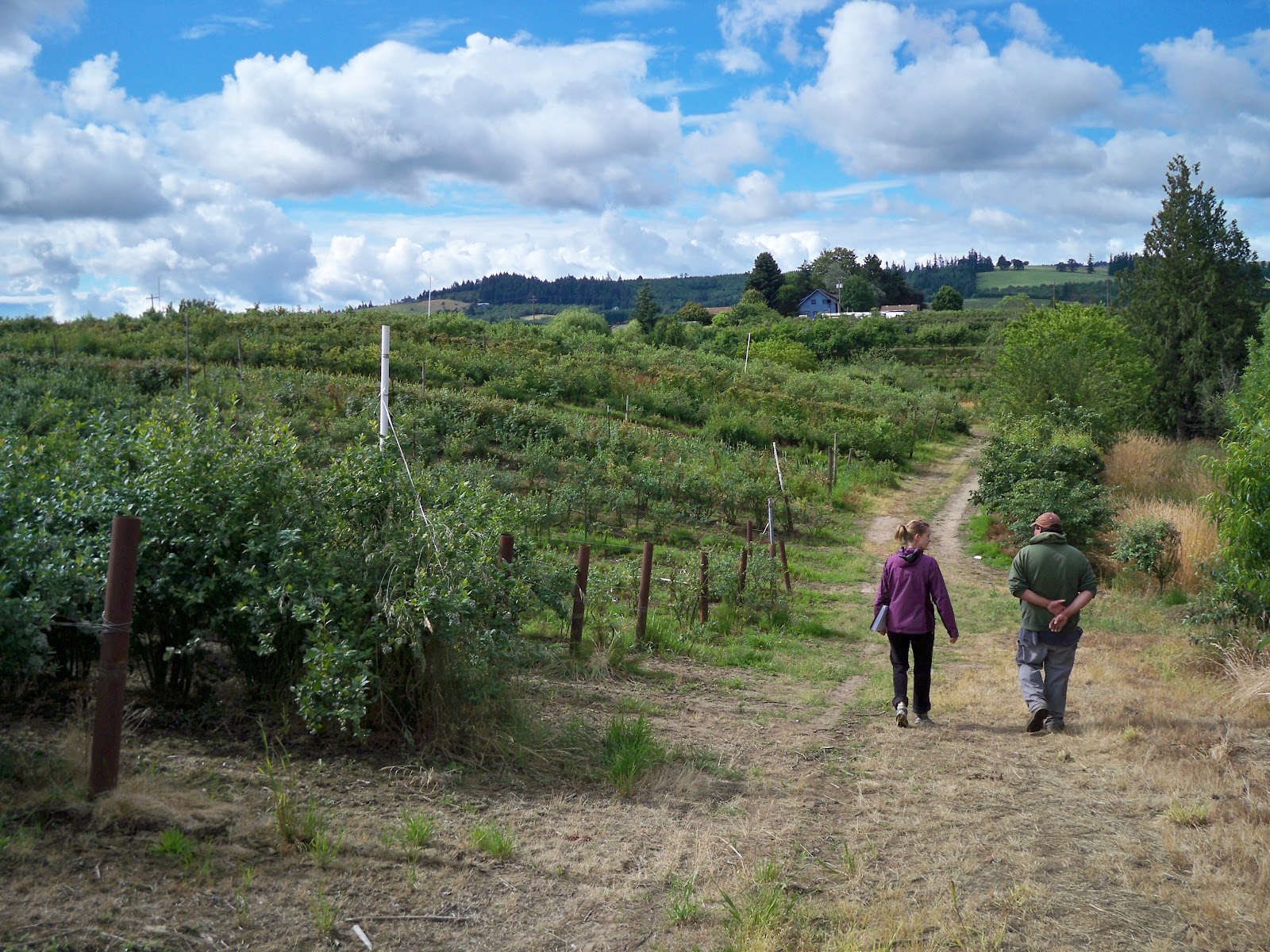
This week market manager Kaely Summers and I visited Crawford's Nursery, one of the produce vendors at the farmers market.  Their specialties are berries and fruits: blueberries, tayberries, cherries, raspberries, gooseberries, currants, and mulberries are all finally here.  Quince, pears, apples, apricots, and a variety of other produce are also on their way later in the season.  In addition to selling at farmers markets, Crawford's has U-Pick plots and a farms stand in Cornelius.


Berries headed to market

Early raspberries are finally here

Scapes on hardneck garlic

Bees to pollinate all of the fruits

Baby quince

Touring the farm

Market Updates
The Forest Grove Farmers Market is busy with the start of summer produce, our Market Sprouts kid's club, and the start of the WIC Fruit and Veggie Vouchers and Farm Direct Checks.  It's great to see new visitors to the market of all ages and backgrounds.  Next week we take a break from market because it falls on the 4th of July.

Here's the Crawford's stand, full of cherries

Touching up our market truck

We have had some very lucky weather at the market this season

Erika and Roda passing out tokens for SNAP, WIC, Debit, and Credit

Market Spouts summer kids club activities


Saturday, June 23, 2012

Forest Grove Farmers Market Farm Visits and Farmer Profiles


As part of my internship, one of the fun things I get to do is visit farms that are selling product at the Forest Grove Farmers Market with market manager Kaely Summers.  We visit these farms for a few reasons:


  1. It allows us to confirm that what is being sold at the market is being grown by the farmer.  (Unfortunately, sometimes vendors choose to buy products from other farmers and label it as their own.)
  2. It allows us to get to know the farmers and their stories better.
  3. It allows us to better answer questions asked by customers at the market.
  4. It’s fun!
Reason #2 has really resonated with me so far as I get to speak with the farmers in a way that I can’t at the farmers market because we are always so busy there.  We’ve met a lot of creative and passionate farmers so far, each with some unique stories about how they got into agriculture.

Here are some brief profiles of our farm visits thus far:

This farm’s big product (as suggested by its title) is bison meat.  They raise most of their bison out in Central Oregon, but they keep some bison for breeding at their farm in Forest Grove.  Members of the L-Bar-T Bison family also raise a variety of eggs (duck, chicken, and quail) and some produce.


The Epler family runs the ranch.

These bison are raised on pasture but their diet is supplemented by some grains.

Tasty


N & N Amaro
Nicolás and Norma Amaro from Hillsboro are graduates of Adelante Agricultura’s sustainable farming course.  They have been selling a variety of produce, plant starts, and eggs at the market for many years.  Up until last year, they farmed together with Nicolás’ brother and his wife, Sabino and Reina (they now farm and sell separately).

Chickens for eggs

Norma's fresh garlic

Plant starts

Peas, tomatoes, and chard in the Amaro's high tunnel.


GX Family Garden
Started by the mother of a family that emigrated from Laos, GX Family Garden raises and sells beautiful flowers.  They have plots in both Corbett and Damascus.  They sell at a variety of farmers markets in the Portland area.

GX Family Garden farms on over 2 acres in their Corbett plots.

Flowers and peas

Billy (daughter of Chue, GX founder) and Erika

Making bouquets at market


Tbees
Tbees, run by Ron Stark, sells honey and pollen at the market.  The hives are located on farms in the vicinity of Scholls and Sherwood.  In addition to being honey and pollen makers, these bees are busy pollinators of local blueberries, raspberries, wildflowers, clover, and more.

Bees store their honey and babies in the honeycomb.

Apiary owner Ron Stark and market manager Kaely.
Each pallet has four hives.

These bees are currently pollinating raspberries and wildflowers.

Ron getting some bees for us to take a closer look.

Honey and pollen at market

Hopefully as we continue to do farm visits I can post more brief profiles here and on the FGFM website.

Sunday, June 17, 2012

Multnomah Food Summit


I was fortunate enough to be able to attend the Multnomah Food Summit on Friday as part of my internship with Adelante Mujeres. This is the third year that the MFS has take place, organized by the Multnomah County's Food Initiative, and this year’s theme was one that I am very passionate about: food justice. I was interested in seeing how the food justice movement was similar to (and different than) what I know about the various agriculture/food movements out in Ohio.

I attended 3 work sessions:
  1. The Next Generation of Oregon Farmers: It was nice to hear that many resources are popping up for young aspiring farmers in Oregon, including urban agriculture training programs, incubator sites, and access to non-traditional land leases and loans. Presenters, including representatives from Friends of Family Farmers and Zenger Farm emphasized how important it is for new farmers to have social support networks as they begin the difficult task of starting their own farm.
  1. Native American Food Hub: Members of the native community, led by 1000 Nations Executive Director Sean Cruz, discussed hopes and challenges of starting a food co-operative in Portland that would support native-produced foods and connect with the larger community. They emphasized their frustrations of being so often forgotten in issues such as food justice. Creating a Native American food hub in Portland is an important part of the healing process for natives who have excellent knowledge of Pacific Northwest foods but who have been ignored and mistreated ever since their land was stolen from them by white people.

  2. Connecting Affordable Housing Residents and Farmers Markets: A study by local organizations found that affordable housing residents value high quality produce, but they cannot get it because the locations that sell produce near affordable housing are not affordable. The study also found that SNAP (food stamps) incentive programs at farmers markets can significantly help make outlets more affordable for SNAP recipients. The next step is to ensure that these farmers markets are close enough to affordable housing for those who live there to attend.

Produce grown by N & N Amaro, started by by graduates of
Adelante Agricultura's sustainable agriculture course.

Adelante Mujeres hosted a session describing their various programs that are working to create just, local food system. You may have read about some of them in my earlier posts:
  • Adelante Agricultura's 12 week sustainable agriculture training program for new Latino farmers
  • Access to ¼ acre on La Esperanza Farm for course graduates
  • Assistance with finding outlets to sell produce (including the Forest Grove Farmers Market and the new La Esperanza Distributor)
  • Space for new Latino entrepreneurs to create value-added food products in the Sabor Color Commercial Kitchen
  • Encouraging low-income participants in Adelante's other programs to use their Adelante Incentive Vouchers, SNAP, or WIC at the Forest Grove Farmers Market
  • Adelante Mujeres's new Nourishing the Community Initiative, which works to promote healthy lifestyles including supporting healthy and local foods

It was nice to see a large group of people who were all passionate about a just and sustainable local food system all in one place. The conference had over 300 attendees. However, there are still many challenges in Portland’s food justice movement. The original conference schedule, which was meant to be inclusive, did not include any representatives from the native population, sparking outcry from Native American individuals and organizations. Also, the conference attendees were predominantly 30-something white females. To ensure a food justice movement that is truly inclusive, there needs to be a more diverse population- I know Portland has more than young white females. Lastly, there seems to be divisions between what is the best strategy from making Portland’s food system more just- some seemed to disapprove of welfare programs while others wanted to increase welfare benefits. It will be interesting to see how these conversations of food justice move forward in the coming years.

Thursday, June 14, 2012

Farm Visits

Reindeer Farm, Alaska, 2002

L-Bar-T Bison Ranch, Oregon, 2012


My dad pointed out how similar these photos were to me.

A more in-depth post on something actually work-related will be on its way in the next few days.

ET

Sunday, June 3, 2012

Adelante Padres


A nice day on the farm

Saturday was devoted to starting the building of the produce washing station at La Esperanza Farm.  The washing station is an area that will be used to wash and dry produce and storage bins after it has been harvested to ensure that it is clean and ready to be sold at the farmer's market or to La Esperanza Distributors.  Karin (an Americorps volunteer at Adelante Mujeres) has wanted to set up this washing station for a while and so it was nice to finally see a tangible result.

We recruited our dads to help in the design and building of the washing station: four washing tables (each with ½ of a 55 gallon drum as a sink), four drying tables, and a handwashing sink in the covered area of the farm’s bodega.  We thought a fitting title for the washing station would be the “Adelante Padres” lavadero.  The four of us, plus Anne (Adelante Agricultura Program Coordinator) and Sharon (Adelante Mujeres volunteer) spent the day cutting wood, laying down gravel, and putting together 2 washing tables and 1 drying table.  We still need to tackle the rest of the tables and plumbing- but that's another day's adventure.


Unloading the 2 x 4s

Laying down gravel

Russ (Karin's dad) and Hiroshi (my dad) working on cutting the 55 gallon barrel

Karin, Sharon, and Anne figuring out how to get the water out of the second barrel

Hiroshi and washing table

Completed washing table

Karin and Hiroshi working on first drying table

Drying table in progress

Completed drying table

Our finished products for the day

Monday, May 28, 2012

Improving Access at Farmers Markets


Farmers markets are often stereotyped as venues accessed primarily by upper-middle class, white individuals, because of where they are located or what forms of payment they accept.  However, fresh and tasty produce should not be reserved for those who lack barriers to access, and in the past few years a number of organizations have been working to improve access to fresh fruits and veggies at farmers markets.

Adelante Mujeres has been very engaged in the issues of access at the Forest Grove Farmers Market.  The market accepts a variety of federal nutrition program benefits which are given to low-income individuals and families including SNAP (Supplemental Nutrition Assistance Program, more commonly known as food stamps), WIC Fruits& Veggies vouchers, and Oregon Farm Direct checks


The Forest Grove Farmers Market (FGFM) also participates in Wholesome Wave’s match program, where SNAP, WIC, and Farm Direct recipients can receive up to an additional $10 each market day which shoppers can use to purchase any fruits, vegetables, or plant starts sold by vendors.  This is an extremely popular program for FGFM attendees.  Wholesome Wave, a Connecticut-based NGO that focuses on uplifting small farms and creating food security, began the Double Value Coupon Program in 2008 in order to increase federal nutrition program benefits and improve local food economies.  Today, there are about 300 farmers markets participating in this matching program throughout the United States.

The Double Value Coupon Program has significantly grown since
 its inception and extended federal nutrition benefits.
(Click on the figure to enlarge it)

Even with these improved access policies, there is still the question of race.  The market was started by Adelante Mujeres which works to improve the lives of low-income Latina women and their families - one important feature of this mission would be ensuring that this community knows about the market and its options for access.  While a number of volunteers and vendors are graduates of Adelante Mujeres’ adult education, micro-enterprise, or sustainable agriculture programs, the Latino presence in terms of consumers at the market is relatively low compared to the portion of the Forest Grove population that they represent.  Thus, Adelante Mujeres has recently started handing out Adelante Incentive vouchers, which are good for $10 of produce at the market.  Adelante Incentive vouchers are given to women in the Adelante Mujeres’ adult education class as a reward for good attendance, and young women in the Adelante Chicas program will also hopefully soon receive vouchers.  There are also goals of expanding this Incentive program to provide vouchers to Latinos who are involved in other local organizations.

Lastly, the FGFM hosts some special events that also try to improve access.  The target populations for these events are seniors (Senior Day on May 30th), youth (a kid’s club takes place all summer), and students (Student Day on September 26th).  There are also events that focus on health and safety (Bike Day on June 13th and Wellness Day on June 27th).

Photo courtesy of Shawn Linehan and Adelante Mujeres
Many farmers markets still do not accept food stamps, which is a shame when nearly ½ million Americans are enrolled in the SNAP program.  These farmers markets, while perhaps doing so unconsciously, are continuing to reserve fresh, tasty, local, friendly, community-centered food for those who can access and afford it.  We need all farmers markets to start accepting federal nutrition benefits as forms of payment and to participate in programs that increase these benefits such as Wholesome Wave’s Double Value Coupon Program.

Saturday, May 26, 2012

Follow Adelante Mujeres' Blog

I'm going to be posting some short articles on Adelante Mujeres' blog if you'd like to read them.  It's also a good place to learn more about the organization.

The Forest Grove Farmers Market went well this week and hopefully as the weather begins to warm up the vendor and buyer attendance at the market will continue to improve.  In addition to market, I've been working on trying to finalize a budget for Esperanza Distributor supplies, creating a post-harvest handling crop specifics guide for La Esperanza farmers, and have roped my dad into helping build a produce washing station at the farm.

Photos from market on the 24th (there aren't a ton of people because it was before the market had actually opened).  As usual you can click on any photo to enlarge it.

Adelante Mujeres' market truck

Market sign: pardon my imperfect Spanish.

Amaro's Produce, graduates of Adelante Agricultura's sustainable agriculture class.