Monday, May 28, 2012

Improving Access at Farmers Markets


Farmers markets are often stereotyped as venues accessed primarily by upper-middle class, white individuals, because of where they are located or what forms of payment they accept.  However, fresh and tasty produce should not be reserved for those who lack barriers to access, and in the past few years a number of organizations have been working to improve access to fresh fruits and veggies at farmers markets.

Adelante Mujeres has been very engaged in the issues of access at the Forest Grove Farmers Market.  The market accepts a variety of federal nutrition program benefits which are given to low-income individuals and families including SNAP (Supplemental Nutrition Assistance Program, more commonly known as food stamps), WIC Fruits& Veggies vouchers, and Oregon Farm Direct checks


The Forest Grove Farmers Market (FGFM) also participates in Wholesome Wave’s match program, where SNAP, WIC, and Farm Direct recipients can receive up to an additional $10 each market day which shoppers can use to purchase any fruits, vegetables, or plant starts sold by vendors.  This is an extremely popular program for FGFM attendees.  Wholesome Wave, a Connecticut-based NGO that focuses on uplifting small farms and creating food security, began the Double Value Coupon Program in 2008 in order to increase federal nutrition program benefits and improve local food economies.  Today, there are about 300 farmers markets participating in this matching program throughout the United States.

The Double Value Coupon Program has significantly grown since
 its inception and extended federal nutrition benefits.
(Click on the figure to enlarge it)

Even with these improved access policies, there is still the question of race.  The market was started by Adelante Mujeres which works to improve the lives of low-income Latina women and their families - one important feature of this mission would be ensuring that this community knows about the market and its options for access.  While a number of volunteers and vendors are graduates of Adelante Mujeres’ adult education, micro-enterprise, or sustainable agriculture programs, the Latino presence in terms of consumers at the market is relatively low compared to the portion of the Forest Grove population that they represent.  Thus, Adelante Mujeres has recently started handing out Adelante Incentive vouchers, which are good for $10 of produce at the market.  Adelante Incentive vouchers are given to women in the Adelante Mujeres’ adult education class as a reward for good attendance, and young women in the Adelante Chicas program will also hopefully soon receive vouchers.  There are also goals of expanding this Incentive program to provide vouchers to Latinos who are involved in other local organizations.

Lastly, the FGFM hosts some special events that also try to improve access.  The target populations for these events are seniors (Senior Day on May 30th), youth (a kid’s club takes place all summer), and students (Student Day on September 26th).  There are also events that focus on health and safety (Bike Day on June 13th and Wellness Day on June 27th).

Photo courtesy of Shawn Linehan and Adelante Mujeres
Many farmers markets still do not accept food stamps, which is a shame when nearly ½ million Americans are enrolled in the SNAP program.  These farmers markets, while perhaps doing so unconsciously, are continuing to reserve fresh, tasty, local, friendly, community-centered food for those who can access and afford it.  We need all farmers markets to start accepting federal nutrition benefits as forms of payment and to participate in programs that increase these benefits such as Wholesome Wave’s Double Value Coupon Program.

Saturday, May 26, 2012

Follow Adelante Mujeres' Blog

I'm going to be posting some short articles on Adelante Mujeres' blog if you'd like to read them.  It's also a good place to learn more about the organization.

The Forest Grove Farmers Market went well this week and hopefully as the weather begins to warm up the vendor and buyer attendance at the market will continue to improve.  In addition to market, I've been working on trying to finalize a budget for Esperanza Distributor supplies, creating a post-harvest handling crop specifics guide for La Esperanza farmers, and have roped my dad into helping build a produce washing station at the farm.

Photos from market on the 24th (there aren't a ton of people because it was before the market had actually opened).  As usual you can click on any photo to enlarge it.

Adelante Mujeres' market truck

Market sign: pardon my imperfect Spanish.

Amaro's Produce, graduates of Adelante Agricultura's sustainable agriculture class.

Monday, May 21, 2012

Summer 2012 with Adelante Mujeres


La Esperanza- Please click on me to enlarge.

Hello everyone,

Welcome to the summer 2012 edition of my blog. For the next 2 months or so I will be interning with Adelante Mujeres in Forest Grove, Oregon. This is an organization which I volunteered with in the summer of 2009 and really wanted to re-connect with, so I set up an internship proposal with them and then received funding from my college to do it, so here I am!

Adelante Mujeres is a non-profit organization whose mission is the education and empowerment of Latina women and their families. Their main focus is adult and early childhood education courses, but the organization wears many other hats. In addition to holistic education, they have a girls empowerment program and a small business development (micro-enterprise) program.

For the summer I am more or less situated under the micro-enterprise division with the Adelante Agricultura program. Adelante Agricultura provides a 12-week sustainable agriculture training course to interested participants, and upon completion graduates have access to start their own small farming operation on a portion of Adelante Mujeres’ organic-certified La Esperanza Farm. I will be helping out occasionally with the demonstration plot at the farm, which the Adelante staff uses to teach agricultural principles.
Adelante Agricultura also operates the Forest Grove Farmer’s Market (founded by Adelante Mujeres in 2005). Some graduates of the Agricultura class sell their produce here (but the majority are too small or too busy), and a variety of other types of vendors from the local community also sell at the market. Every Wednesday I will be helping with the set-up and general operation of the market, which I also helped with back in 2009.

A third main task I have this summer is helping with the start up of La Esperanza Distributors, a project which Adelante Mujeres is creating in order to help the new farmers at La Esperanza Farm sell their produce. As with any produce distributor, farmers will sell their product to the distributor and the distributor will then sell product in bulk to local businesses. In the case of La Esperanza Distributors, the buyer is Adelante Mujeres and the local businesses who are buying the bulk product will be local school districts, local businesses, and local grocers. The buyer list includes Intel (serviced by Bon Apetit), New Seasons, and Head Start. As I research different supplies and procedures we will need to make La Esperanza a success and helpful for the farmers, I am finding that my 2010 summer with Green Corps (a group of 6 education-focused urban farms in Cleveland, Ohio) is coming in really handy.

I hope to post a blog every week about what I’ve been up to with the ag program at Adelante. I’ve already had 5 days of work thus far and have really enjoyed it: Adelante Mujeres is full of some really great, friendly, hardworking staff who are motivated to help me succeed in my internship.

Peace,
ET

P.S. About the photo: I spent Saturday untangling drip tape and doing some planting on the demonstration plot at La Esperanza, and all the farmers were out on their own plots doing the same. They couldn’t get anything in the ground earlier because the land was flooded during the winter months and the soil needed time to dry out. Thankfully, the farm also has a nice greenhouse where the plant starts are growing really well.

Monday, March 26, 2012

On the US-Mexico Border with BorderLinks


This spring break I had the opportunity to participate in a week-long BorderLinks delegation to Tucson, Arizona and Nogales, Sonora with a group from Westminster Presbyterian Church and The College of Wooster (both from Wooster, Ohio).  BorderLinks is an educational organization that facilitates experiential learning on US-Mexico border issues.  Attending a high school that was interested in social justice issues and volunteering with local non-profits such as Adelante Mujeres, I was one of a seemingly small group of Americans that had learned at least a little bit about immigration between the US and Latin America.  Additionally, my involvement with the movement to shut down the School of the Americas has increased my knowledge of the US’ impact on other nations, often in the form of economic marginalization or militarization, which causes the subsequent need for impoverished or endangered persons to migrate.  Even with some prior knowledge, this trip provided me with a mosaic of immigration with greatly deepened my understanding of the bigger picture and also gave more “faces” to the issue.  I was able to meet and talk with countless individuals who were migrating, had been deported, or had friends and family in these situations.

The migration from Mexico to the United States is a phenomenon that has existed for a long time; however, when Bill Clinton signed NAFTA in 1994 the situation in Mexico worsened.  NAFTA meant that the United States could export products to Mexico with no taxes or tariffs, meaning that many US products (especially its subsidized corn) were cheaper for Mexicans to purchase than what was produced within the country.  Unfortunately the situation was not the same for Mexican products entering into the United States- these products still face high taxes and tariffs, so NAFTA wasn’t really created for “free trade” but a means to enhance the US economy at the expense of others.  Mexican businesses began to struggle and many families (especially those in the southern agricultural areas) have found it impossible to make a living.  Increased numbers of people (especially males) began to migrate to the north in hopes of finding a job that could pay decent wages and send some money back to the family.  This migration was to the United States or the newly formed maquiladoras along the US-Mexico border, which are large mass production facilities for US corporations that were created because of the availability of cheap Mexican labor.  The economic instability is getting so bad now that women are now joining the men in search of a job in the north.

President Clinton didn’t just sign NAFTA into law in 1994.  He also began to militarize the US-Mexico border, putting up a gigantic wall along urban border regions and heightened security, making it significantly more difficult for people to cross.  A simple hole in the border fence wouldn’t cut it anymore.  Thus, migrants were forced to cross to the United States in the desert, a dangerous area which requires many days of walking with little food or water to reach an urban area that will have transportation to a migrant’s final destination.  Deaths in the desert are frequent and multiple bodies are found every week.  I had the chance to participate in a desert walk on a popular migrant trail area just south of Tucson.  I was struggling to navigate the terrain in daylight while being well-fed, clothed, and hydrated.  I could barely imagine walking through the area at night (when it is much harder to be spotted) and fearing danger.  Thorny cactus, bad blisters, cold nights, and border patrol aren’t the only worries.  There has been increased violence against migrants in both the desert and urban areas, including kidnapping until families send bail money, forcing migrants to carry bales of marijuana on their backs, and raping of women.

Violence from other problems (like drugs, fueled by demand in US) is also causing migration.  This need for migration is closely linked to the SOA, as seen for example by the recent SOA Watch border delegation which discovered the high numbers of SOA graduates on both sides of the drug conflict.  The US’ militarization of Latin America is causing increased violence in areas where countless innocent individuals are living; this political unrest (especially currently from Mexico and Honduras) means that many people are also leaving their homes not just to make money but to live somewhere that is safer.  Unfortunately it is currently very difficult for Latin Americans to be granted asylum in the United States, except in the form of sanctuary by many organizations involved in the sanctuary movement.
US militarization doesn’t just affect people of Latin American descent outside of the US borders.  It is alive and well within the US too, criminalizing individuals who are trying feed their children instead of addressing underlying structures that are causing this poverty (caused mainly by the US itself- it’s a lose-lose for migrants!).  In Arizona, SB 1070 allows for officers to ask persons for their documentation of legal status in the United States as they please.  It also prevents day laborers from setting up hiring locations in public spaces, does not allow undocumented persons to ask for jobs, and makes it illegal for citizens to live with or drive undocumented individuals. SB 1070 is essentially legal racial profiling. A newer policy step, the ethnic studies suspension in public schools, means that people can no longer learn the history of Mexican Americans and understand their distinct roots.  (Of course, the idea is that immigrants will not become empowered to end injustices because they won’t learn about histories of colonization and continuing imperialism.) 
Arizona also has new intensive deportation programs that include increased sentencing of migrants with specific charges placed on their criminal record (rather than simply tossing them back over the border) in the Operation Streamline program.  I witnessed 70 migrants sentenced to deportation in court and some received prison sentences in our nation’s growing privatized prisons which costs the government about $120 per person per day.  Operation Streamline is not evenknown to be effective at decreasing deportations.  One of the most evil policies I learned about was the splitting up of family members upon deportation to ensure that migrants are as disoriented as possible when they are thrown back across the border.  The court, imprisonment, and deportation policies, as well as the patrolling by Homeland Security’s various divisions, are extremely expensive.  Those of us that pay taxes are paying for these practices.  What if we used all of those funds to create programs that could help people in poverty?
Part of a BorderLinks delegation is seeing the variety of NGOs, faith groups, community organizations, youth, and artists that are all very involved in the struggles with immigration & the border on both the US and Mexico side.  Southside PresbyterianChurch has been involved in the sanctuary movement since its inception during the violence in Latin America in the 1980s, providing a safe place for those seeking asylum from violence in their home countries.  The church property also has a migrant shrine and a day laborer center.  Green Valley Samaritans and Tucson Samaritans organize desert walks to provide aid to migrants and search for bodies of those who have deceased in the desert.  HumaneBorders sets up emergency water stations in the desert.  No More Deaths researches violence against migrants and works to end deaths along the border.  Border Action Network and Coalición de Derechos Humanos make sure that immigrants know their rights and are able to defend themselves according the law and constitution when they are stopped by police.  El Libro-Traficante is working to bring back books that were banned in part of the ethnic studies suspension injustices.

On the Sonora, Mexico side, El Hogar de Esperanza y Paz operates as a community center that provides food for neighborhood children, workshops on the Culture of Peace, a women’s cooperative, and education programs for both children and adults.  Transportes Fronterizos, El Comedor, the government center for deportedminors, and the Kino Border Initiative provide support to recently deported migrants in the form of discounted bus fare, food, clothing, phones to call home, counseling, and simple housing.  Nogales, Sonora is blooming with new artists who are tackling border issues via theater and visual art such as Yonke.

Over and over again, I heard hopeful individuals tell their stories of migration and suffering that I do not believe any human being should have to endure.  Over and over again, these individuals said that all they wanted was a job.  A simple job.  They did not want to get in anyone’s way, they just wanted to make a little money to send home and feed their families.  Those that had lived in the United States found Americans to be very friendly and helpful and couldn’t understand why Latin Americans were being discriminated against.  I feel the same way.  Just because a human being lives on a different side of an arbitrarily constructed line does not mean that they should not be able to attain a decent livelihood.  Oppressive policies of the United States benefit a very select group of people while disenfranchising the rest, and our government refuses to help those who have lost out in this process.  I do not know how to get rid of policies such as NAFTA and border militarization but I know that they need to be abolished if we want to prevent the continued impoverishment of millions of people in Mexico and beyond.

I would encourage all those who work for peace and justice to organize a BorderLinks delegation in their home communities to see these issues first hand.  I can guarantee that even if it only takes up a few days of your time it will change your life as you realize the responsibility you have to work for a more humane immigration system.  Together as groups of grassroots communities we can work to end the various unjust US policies that promote militarization, neocolonialism, racism, and injustice.

Update: Thank you to Dick Beery for the great photos.

Our delegation (left to right): Justin  (BorderLinks intern from Columbus, OH), Amanda, Scott (US trip leader), Giang, Nileema, Dries (Westminster pastor), Beth (Westminster student ministry coordinator), Wyatt, MaryCruz (Mexico trip leader), Alex, Erika, Dick
Before our desert walk. Items on the table were found in the desert, left behind by migrants.
Elias (teacher at El Hogar de Esperanza y Paz) plays some guitar for us.

Josue from Honduras, who shared his story with us at El Comedor in Nogales.
Mural by Taller Yonke artists Guadalupe Serrano and Alberto Morackis at El Hogar de Esperanza y Paz.
Dries, Beth, and Erika at El Hogar de Esperanza y Paz in Nogales.
Along the wall, US side.


Our FANTASTIC trip leaders MaryCruz and Scott.
MaryCruz and Elias.

Tuesday, January 17, 2012

A short reflection on Thailand


I have been in the States for less than a week, and thus my experience in Thailand is still a very large part of my daily thoughts (heck, my experience in India is still a very large part of my daily thoughts).  Processing experiences abroad seems to take a long time and I would not be surprised if it was a lifelong process.  Thus, I do believe that my reflections on my travels in Thailand will develop and change over time.  Here are some things I have been thinking about in the past few days. 

1.  I learned a lot about ways to approach life changes, especially death, in ways other than sadness or anger.  I heard many Thai people talk about taking life day by day, without regretting the past or worrying about the future.  I also saw that when someone died, people did not just completely shut down with mourning.  A funeral was not just a place to cry but also to celebrate and enjoy the company of a community.  I think that Thai people had a nice balance of emotions and were much more accepting of life changes.  They seemed to “go with the flow” much better than we do here in the States, where we will stop at nothing to retain our American lifestyle of valuing youth and high consumption.

2. This second point relates to the emphasis of taking life day by day without regretting or worrying.  I think it also has to do a lot with different perception of time: the idea of schedules, due dates, and plans seem are not as rigid in the Thailand that I experienced.  Thailand seemed like a country where stress did not exist.  I’m not sure if this was me oversimplifying (it probably was), but at least the notion of anxiety was nowhere near as prevalent as it is in the American society that I inhabit.  Since I have returned I have tried to live without a constant feeling of avoiding stress, being stressed, working in a hurry, or focusing on deadlines.  My question is this: Can I live without a concept of stress at The College of Wooster, an environment which I have always perceived as very high-stress because of how hard I expect myself to work?  Some people think that at least a little bit of stress can be very helpful in achieving one’s goals.  So far, I am feeling very good with my “no stress” attitude and I seem to be doing alright with just taking things as they come.  Will it survive?

3. Can the way we approach spirituality and religion in the US be changed?  I have seen how intertwined and fluid spiritual life is with the rest of society in other nations and think that this can really enhance one’s quality of life.  It may even, if practiced correctly, lead to a more ethical life.  (However, as I have seen in Thailand, religion can often be used as a form of oppression.)  In Thailand, I really appreciated how spirituality, faith, religion, etc. did not need to be put into boxes like it does in the United States.  It bothers me here how much emphasis we put on separating church from state (even if that doesn’t really exist), how we judge people based upon their religion, and how we say that people who aren’t part of a specific religion are not religious people.  Why is it so important that we are a Christian or a Muslim or a Jew or an Atheist?  And why is it so important that we often seem to keep our own faith practices hidden or separate?  After all, we are all human beings.  Even if we practice different forms of spirituality, we could still at least talk about them or use them for the common good.  I saw some examples of these practices in Thailand, such as in HIV/AIDS work.  I also saw the acceptance of many forms of spiritual practice in Doi Lan, the Li Su village.

4.  Thailand appeared to be a very hierarchical country, with so much emphasis placed on the king and also one’s own personal status.  Despite how Thailand is often portrayed in international media, it did not seem like any more of an unstable nation than any other country I have visited or lived in.  I learn a lot in my sustainability classes about how development is best when it is a grassroots, bottom-up initiative.  So what about the case of Thailand, which appears on the surface at least to be the exact opposite?  (Note that I am someone who is a big advocate for bottom-up development, and even I am asking this question.  Perhaps everything is not so black and white.)

It’s still hard for me to write even these comments down because I feel unsure of what I write about.  In the end I leave with more questions that I started with.  However, I am very thankful to have had this trip.  I am especially very grateful for getting to meet and learn from many unique people while in Thailand.  My weekly Asian and Asian American Feminist Theology course starts tomorrow night and so I get to continue questioning.  Thus, I hope to continue to write follow-up posts on topics such as those that I touched on above.  (Also, a sneak peak at my next “abroad” experience: driving from Tucson, Arizona to Nogales, Mexico with a BorderLinks educational experience in March.)

Here's to feeling stress-free in Thailand and the US.  (Hopefully that also goes for my Li Su cat friend.)

Sunday, January 15, 2012

Back in the States

Dear friends,

I am back in the States now and will drive from Allen Park, MI to Wooster, OH in about 12 hours.  I haven't been able to muster up a reflection post yet, but hopefully I can have one in the coming week.  In the meantime here are some photos I would like to share with you.

International Women's Partnership for Peace and Justice visit
Anna and Liz's blog post on the visit
IWP's website

Soybean fields at IWP.  Just like Ohio, right?

Ginger, our IWP host, was using these bricks to build her new home.

Visit to Doi Lan, a LiSu village
The LiSu are an ethnic minority of northern Thailand and Burma.  We stayed in a village of about 100 households, called Doi Lan, for 3 nights at the end of our stay in Thailand.
Nancy and Abby's blog post about our last full day in Doi Lan


My host family was drying beans outside when we arrived.

After Thai government programs to eradicate opium production, coffee has become a main crop for Doi Lan.

Doi Lan seemed to have the best food in all of Thailand.  This is sticky rice, similar to mochi, toasted with cinnamon and sugar.

Eggs, tomatoes, cilantro, squash, greens, rice.

One of our furry and flea-filled friends.

The largest livestock which the people in Doi Lan raise are pigs.

Celeste, Erin, and cat in front of our host family's house and kitchen.

Some more of our furry friends.

Coffee tree starts.

The school garden.

A view of the hills.  Much of the area has been deforested.

Can you tell that Celeste, Erin, and I spent most of our time playing with animals?

A visit to Doi Chaang's luxury coffee production operation.

The first rice and pig slaughter ceremony.

Our host parents (Asapa and Alima) weighing and selling their beans on our last morning in the village.


Last Day in Bangkok

The Erawan Museum's 5-story 3-headed elephant.

At the top of the elephant structure is a room filled with centuries-old buddha figures from various kingdoms in Thailand.

The Erawan Museum also had beautiful flowers spread across their grounds.

Too bad these don't grow as well in the Midwest.

We used the skytrain as a nice alternative to Bangkok's road traffic.


Friday, January 6, 2012

Doi Suthep, Chiang Mai

Yesterday our class visited Doi Suthep, a large mountain in Chiang Mai which has a famous wat (temple) at the top.

Heading up the mountain (there's Ken in front of us).

There are 3 objects often involved in making an offering: 1. Two candles, which represent the teachings of the Buddha (both what to do, and what not to do).  2. Three incense sticks, representing the 3 qualities of Buddha: purified, wise, and full of loving kindness.  3. One lotus flower, representing well-practised monks that show that no matter who you are, you can become a spiritually beautiful person.

These bells surround the wat and anyone can ring them (such as Erin and Anna).  They can be very popular for children, or children at heart.

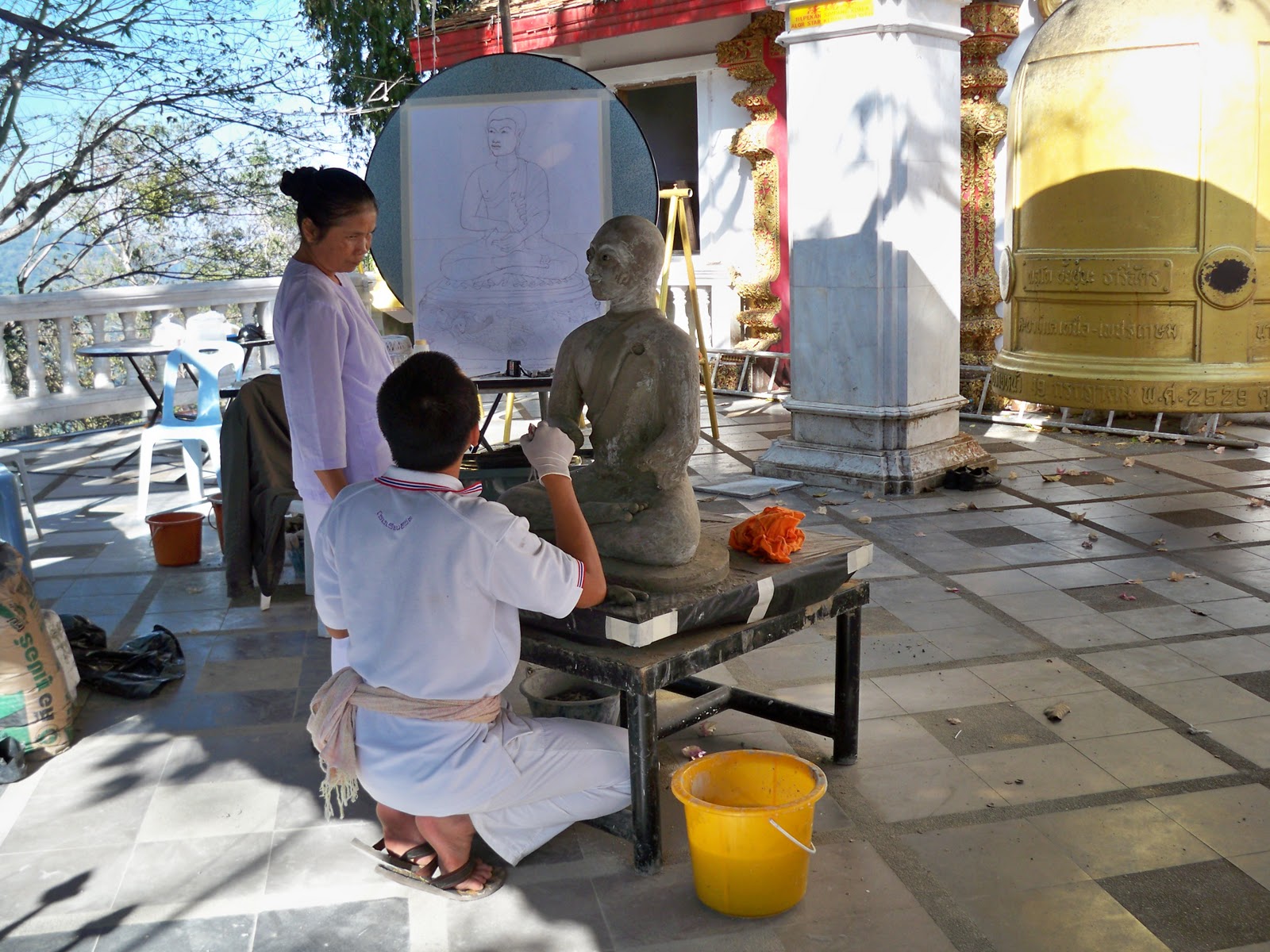
Here is a man creating a statue of a famous monk.  You can see the drawing of the monk in the background.

A view of Chiang Mai from the top of the mountain.


A mythical creature, taken from Hinduism, which connects water and sky because of its physical features.

The large pagoda represents the residence of Buddha.

We saw many Buddha images, each of which represent the image of Buddha according to certain group of people.  The first Buddha image was not constructed until 500 to 700 years after the death of Buddha.  This original image was constructed by Greeks, and then later went from India to Burma to Lanna to Sukhothai (Thailand).

Heading back down the snake-lined stairway to the bottom of the hill.