Tuesday, July 21, 2015

Recent sights


Please enjoy these photos from my activities in the past 2 weeks.

Matagalpa
I traveled up north with Kira and Alicja (the other 2 ATC interns) to meet with ATC Matagalpa staff.  We interviewed them about the history of ATC Matagalpa and the work it currently is doing with dozens of unions and cooperatives in the region, with a particular focus on gender equity and youth initiatives.  While in Matagalpa, we also explored the city's steep streets, refreshed ourselves in the cooler climate, and observed feminist graffiti.

Matagalpa is in the northern mountainous region of Nicaragua.

Steep.

Some of ATC Matagalpa's staff + ATC interns

"Feminist, because I believe this society must include me and you."

"Neither the earth nor women are territory to be conquered."


Santa Emilia
Outside of the city of Matagalpa in the small village of Santa Emilia is one of ATC's schools.  At this school, we participated in a workshop for youth who are members of local (coffee, vegetable, grain) cooperatives in the departments of Matagalpa and Jinotega.  My favorite part was the practicum on biofertilizer.  We also explored the grounds of the school, which includes some agroecological production spaces.

Entrance to the school in Santa Emilia

Kira and Alicja on the school grounds.

The school keeps a number of cows on pasture.

Erika enjoying some of the cane and moringa plants on the farm.

Coffee

Vermiculture

Youth making biofertilizer!

Don Freddy demonstrates how to build the biofer barrel.


Jinotega
In addition to our internship tasks with the ATC in Matagalpa and Santa Emilia, we took a side trip to see this quaint town and drink local cooperative coffee.

Alicja and Erika by Jinotega's central park.

Jinotega is known for its coffee.

Soppexcca cooperative coffee.

More street art (from the Frente Sandinista).


Aniversario de la Día de la Revolución  
36 years ago on July 19th, 1979, the Sandanista front (FSLN) entered Managua and captured government power from Somoza.  Every year since then, Nicaraguans celebrate the anniversary by converging in Managua's city center.  I participated in the festivities with a group of comunicadores from throughout Central America (who were in town for a strategy session on communication amongst La Via Campesina's member organizations).

Everyone en route to Managua.

The bus caravan.

Some good poses.

At the Plaza de la Fe.

President Daniel Ortega gives a speech in the plaza (shown on the big screen).

More travels to the north and east to come...

Saturday, July 4, 2015

First weeks at the Escuela Campesina


In my first few weeks in Nicaragua, I have been living, learning, and working at the Escuela Obrera Campesina Internacional Francisco Morazán outside of the city center of Managua.  This school is just one of the many hubs of activity of the Asociación de Trabajadores del Campo (ATC) throughout Nicaragua.

Entrance to the school

The ATC works to protect the rights of rural peasant farmers and farmworkers throughout Nicaragua.  It has had a strong presence in the country since the days of the Sandanista revolution and continues to work to defend social gains that have been made for the rural poor.  It operates through unions, cooperatives, popular education, and social movement building, with regular gatherings and trainings for members. 

While the ATC has a long history in Nicaragua, it also has a long history working on the global level as a founding member of La Via Campesina (LVC).  LVC is constructed of 180 organizations representing 79 countries throughout the globe.  The movement grew out of a resistance against neo-liberalism and agribusiness which produces monoculture crops for export, creates dependencies on synthetic inputs and genetically modified seeds, damages the health and economies of local communities, and destroys the planet.  LVC was a leader in developing the concept of food sovereignty which asserts that small-scale, sustainable agriculture and foodways, where rural producers and workers maintain control over their production, is the real way to feed the world.  Food sovereignty strongly values historical knowledge, agrarian reform, culturally appropriate foods, local consumption, and gender equity.

For many years, the ATC has focused on activities such as unions and farmworker rights because many of its members lacked legal access to significant amounts of land for self-production of food (and were instead working on others’ land).  However, more recently, the ATC has integrated into its work a focus on agroecology, a form of agriculture that fits with LVC’s guiding principle of food sovereignty.  Agroecology is a response to conventional industrial agriculture that focuses on low-input, diversified systems that can feed people (and has fed people for centuries).  As LVC’s recent statement from the International Forum on Agroecology asserts, agroecology is more than just a production system: it is a set of principles that “can and are practiced in many different ways, with each sector contributing their own colors of their local reality and culture, while always respecting Mother Earth and our common, shared values."

Being here at the Escuela Campesina has brought to life for me what the La Via Campesina movement can look like in reality, as I have been able to observe some of the activities that go on here day in and day out.  

Workshop in progress (flags from LVC Central America member orgs on ceiling)

Ending just a few days ago was a 10-day leadership formation course for young and old campesinos and campesinas from Nicaragua, Panama, Guatemala, El Salvador, Honduras, and Costa Rica.  Workshop topics included history of colonization in Latin America, political theory (in particular Marxism), food sovereignty, La Via Campesina, popular education, gender, agroecology, worldview, and communication.  I was able to sit in on some parts of the course to get a sense of how ATC education works and learn some new things.  One highlight of the course was having an expert on medicinal plants come and give a workshop, which included bringing to life again an area of the school grounds that was dedicated to medicinal plants in the past.

Medicinal plant area before

Workshop participants learned about medicinal plants...

...then planted them!

more planting

Medicinal plant garden after

In addition to spending time in this leadership formation course, I have been working with other folks here in envisioning how the Escuela Campesina can be more of a production demonstration space.  I’ve been doing some work in the food and medicinal plant gardens and there is hope to integrate and re-integrate other production aspects such as propagation.  I’m learning about some tropical plants that are new to me which is cool.  Doing just a little bit of garden work makes me miss my work previous seasons on farms in Oregon and Ohio.  I am also reminded of how much more I want to learn about all sorts of plants.  

Learning plant propagation with aloe vera!

I'm always taking notes.

Little garden of corn, squash, and beans

Yerba buena

Albahaca china

We transplanted a type of rare bean plant that we hope to use to save seed.

While I work from the Escuela Campesina, much of the ATC team is hard at work on finalizing a proposal to construct the IALA Mesoamerica, or the Latin American Institute of Agroecology.  I hope to write more about this project for you all while I am in Nicaragua.  Stay tuned.

Tuesday, June 16, 2015

Next Adventure: Nicaragua


Dear friends,

Greetings!  I’m writing to you from Nicaragua, my home base for the next 2.5 months as I learn about and support the work of the Asociación de Trabajadores del Campo (ATC), the rural agricultural workers association of Nicaragua.

ATC has been actively involved in social movements in Nicaragua since the 1970s revolution.  ATC is one of the founding members of La Via Campesina, the global food sovereignty social movement that has 160+ member organizations in 70+ countries.  ATC operates IALA Mesoamerica (Latin American Institute of Agroecology) in Nicaragua.  This school brings together individuals and groups from around Central America for workshops, where participants teach and learn about specific agroecological techniques, farmworker rights, political organizing, and more.  ATC and IALA Mesoamerica use popular education, prometora, and campesino a campesino methods of training.

I’m here in Nicaragua to study the core concepts of agroecology, food sovereignty, and political organizing, all of which are important components of the work of La Via Campesina, ATC, and IALA Mesoamerica.  I will be studying Spanish language tailored toward agroecologial food systems and social movements, which is something I have wanted to do for some time now.  Hopefully, I will also participate in some of the planning and/or implementation of the many projects that ATC is working on right now.

For now I am staying at ATC's Escuela Campesina in Ticuantepe (near Managua) but I also hope to spend time in Juigalpa, Matagalpa, and other locations where ATC works.  Stay tuned!

PS: My new buddy Kira (University of Toronto international development student) arrived here the same day as me and will be here for 12 months as part of her studies.  You can read her blog here.

Monday, April 20, 2015

Los Angeles & Food Justice


Last month I participated in one of the UO Holden Center’s Alternative Break trips to Los Angeles. 


The theme of this trip was food justice!  We spent the week meeting with local organizations who are working to make a better food system in Los Angeles, in particular in the South LA (also known as South Central) area.  Here are some of the groups we met, places we visited, and things we learned about along the way.

Some photo credits to Maggie Abney - thanks for sharing.

LA Green Grounds
LA Green Grounds was our wonderful host for the week.  LA Green Grounds is an entirely volunteer-run organization that works to “change turf into edible gardens in South Los Angeles.”  In particular, LAGG focuses on creating edible landscapes in areas that have limited access to fresh, affordable, and local food (you can see a map of where they have worked here).  They also advocate for policies in South LA that support the health of its people and the environment.

We participated in one of LAGG’s “Dig In” sessions at St. Mark’s Lutheran Church, across the street from University of Southern California.  We turned the soil over, added compost and fertilizer, and planted a variety of edible plants.  For many participants on our trip, this was their first time gardening, and they enjoyed learning the basics of gardening.  We also enjoyed meeting and talking with other LAGG volunteers.


Farmers Markets
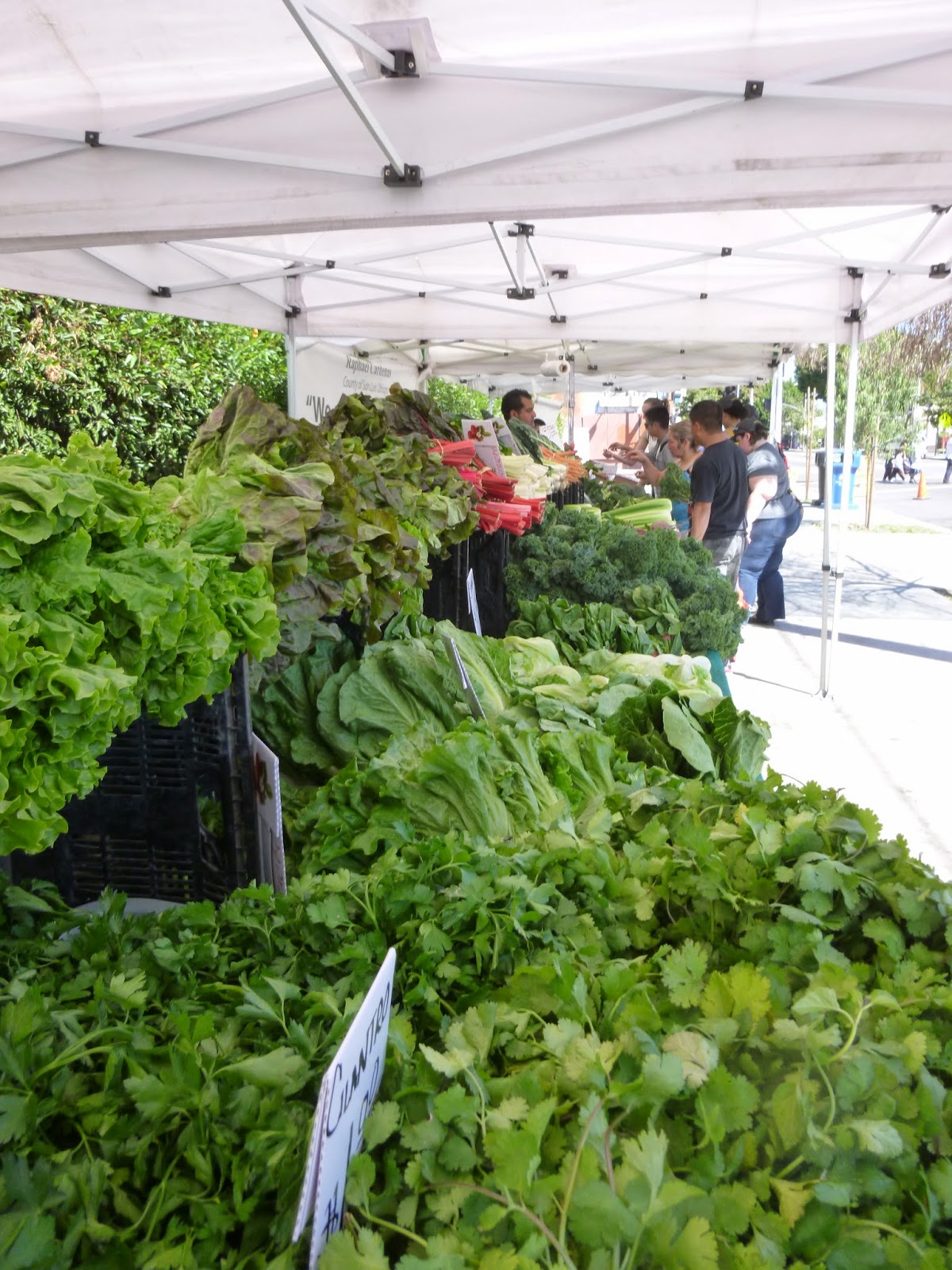
Farmers markets are one way for customers to purchase farm-direct produce.  However, as I’ve discussed in many posts on this blog, there are many potential barriers to farmers markets.  One large barrier is that farmers market produce often costs substantially more than produce at the grocery store, which is why markets have developed a variety of programs that provide extra funds for individuals and families to buy fruits and vegetables at the market.

One of the markets we visited was the Central Avenue Farmers Market, a market whose customer base is primarily Latina women.  This market is operated by the Sustainable Economic Enterprises of Los Angeles (SEE-LA), which offers a Market Match program for SNAP and WIC customers.  This was a small but thriving market with consistent customers and good sales for vendors.


Community Gardens
We visited 3 different community gardens on our trip. 

Glazer Community Garden is overseen by Los Angeles Neighborhood Land Trust, a nonprofit that works to create parks and gardens in areas that lack access to green space.  We had an interesting conversation about how LANLT prioritizes who gets garden plot access (Neighbors? Those in walking distance? People without home garden space? Low-income?), something that is currently being decided on for this particular garden because it is located in a gentrifying neighborhood.


We also visited Ocean View Community Garden, a 6.5 acre nonprofit garden in West LA (which tends to be the more affluent and predominantly white part of LA).  This garden has a 6 year waiting list – an indication that LA needs a lot more community garden spaces. 


The last community garden we visited was Solano Canyon Community Garden, located on a 5 acre slope of land near the LA Dodgers Stadium.  This garden hopes to be a place for at-risk individuals to learn to grow food. 


School Gardens
We visited gardens at Larchmont Charter Schools and 24th Street Elementary School.  Both gardens focus on youth gardening education, cooking, and integrating gardening concepts into core curriculum.  Both of these gardens are managed by nonprofit organizations.  The Edible Schoolyard, known for its original site in Berkeley (co-founded by chef Alice Waters) staffs the garden at Larchmont.  The Garden School Foundation manages the garden at 24th Street Elementary School in addition to 5 other gardens at Title I schools in LA.


Health & Wellness
We sat in on two classes taught by Black Women for Wellness, an organization “committed to healing, educating, and supporting Black Women” and that truly fits its name.  We visited a class that focused on healthful food preparation that was part of the Kitchen Divas and National Diabetes Prevention programs.  We also visited an Urban Chefs Academy class at Crenshaw High School.  These classes were a lot of fun.  We got to speak with class participants and share delicious food.  I appreciated how food was looked at holistically and it wasn’t simply being reduced to nutrition.  


Community Organizing
South Los Angeles neighborhoods have historically been communities of color, due to policies and projects of systematic racism (some discussed on our trip were racial covenants, internment, and incarceration).  However, more recently, due in part to the affordability of housing in the area compared to other parts of LA, more white residents are moving in.  Many South LA neighborhoods are organizing to resist gentrification and maintain control over their communities.

One such neighborhood we visited was Leimert Park, a historic black community.  This community was once a thriving black arts district, but due to crack cocaine and the mass incarceration of people of color, a lot of the local arts culture suffered.  We learned about local arts organizations including the Kaos Network and LA Commons and the work of black business and land owners in revitalizing the local arts.  We also learned about plans to install experimental edible garden space in the neighborhood’s People’s Street Plaza.  All of these community organizing tactics are powerful ways to maintain or reclaim a connection to place as well as resist structural racist policies.


Policy
Lastly, changing unjust policies is one important tactic to building food justice.  We visited Community Health Councils, a nonprofit whose mission is “to promote social justice and achieve equity in community and environmental resources to improve the health of underserved populations.”  They work on policy in LA, especially in South LA, that focuses on environmental health, healthcare, and food access.  Some of their achievements include strong regulations on local oil drilling, funds for grocery store development in South LA (which lacks access to full-service grocery stores), and regulations over new fast food restaurants.  Like Black Women for Wellness, I appreciated CHC’s holistic approach to health and its understanding of how structural policies affect individual health.

***************


This trip only re-affirmed my belief that food justice issues cannot be separated from other social justice issues because of the structural inequalities that are the root causes of them all.  But, this trip also re-affirmed my belief that we all have power in building a more just and sustainable food system for everyone.

A big thanks to Steven Meeks and Florence Nashida of LAGG for organizing the trip and helping us along.  I really valued learning from two people who are leading a multicultural food justice organization in the neighborhoods where they grew up.  Thank you for sharing your knowledge with us.  Keep on growing!