Sunday, September 15, 2013

Wet seed processing at DBF

Seeds!

We are now in the time of year that I’m calling “harvest”- not because harvest doesn’t happen before or after this time, but because much of our time is spent harvesting crops. The summer fruits (like tomatoes and peppers) are ripening with increasing frequency. In addition to edible crops, we’re doing a lot of seed harvests. I’ve described a few different methods of seed harvest and cleaning, but so far they have all been seeds that require a “dry” processing. I’ve now learned about seeds that require a “wet” processing.
We use wet seed processing for our tomatoes, melons, and cucumbers. These crops produce seeds that are enclosed in gelatinous sacks; the seed must be released from the flesh (using water- hence the term “wet”) in order for it be cleaned and dried.
Cucumber seeds in their casings

The process for wet seeding at DBF (with some recent photos) is basically as follows:
Step 1: Harvest crop at full maturity.
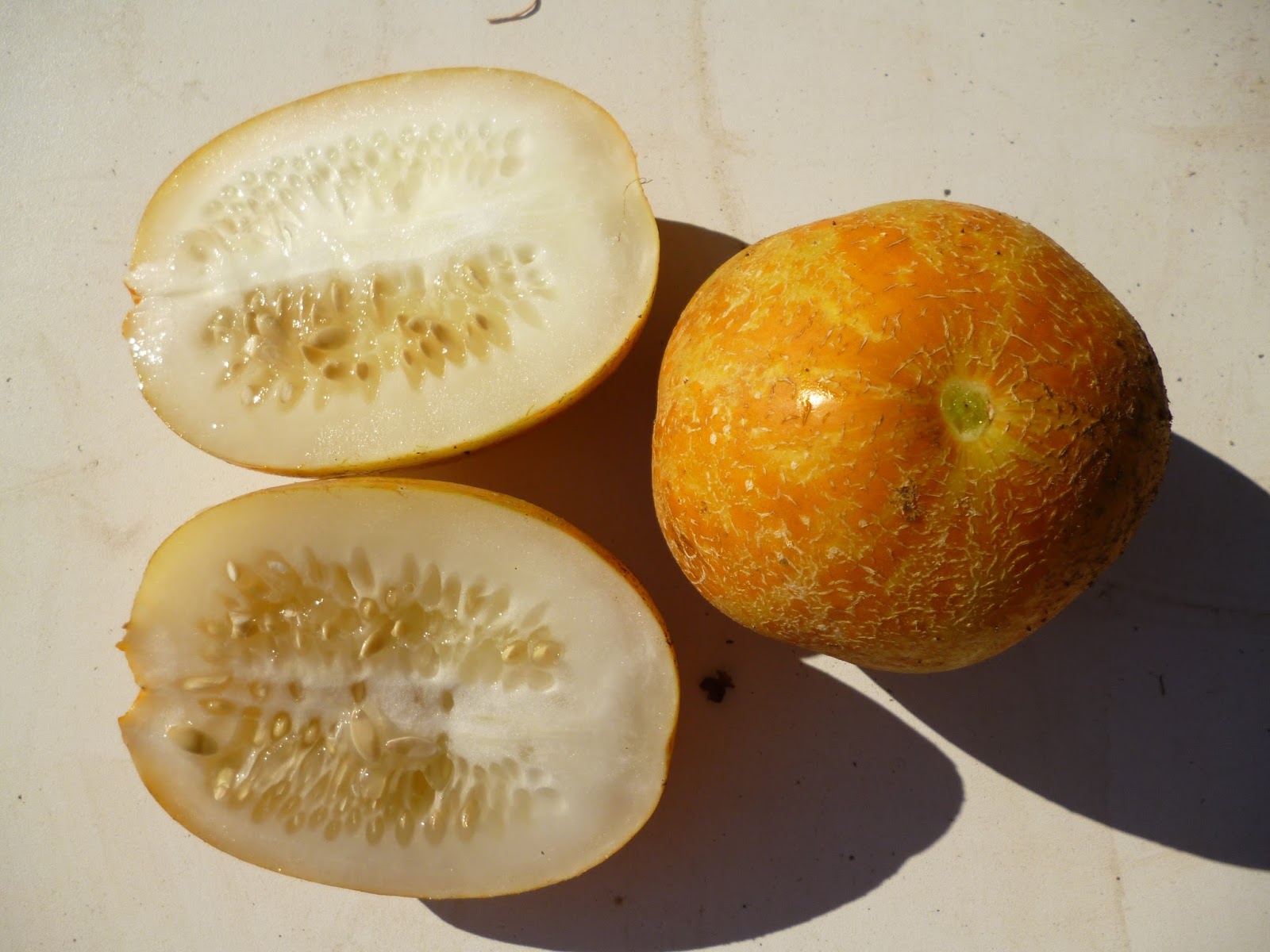
Green Apple cukes with mature seeds

Step 2: Remove seeds (with attached flesh) from the fruit. In melons and cucumbers, this involves cutting them in half and using a spoon to scoop the seeds out. In tomatoes, this involves smashing the tomatoes by hand to release the seeds from the inside.
Scooping seeds out of Rich Sweetness melons

Scooping seeds out of Green Apple cucumbers

We use a bat to smash Sun Gold tomatoes

Step 3: Mix seed-pulp mixture with water in a tall bucket.
Step 4: Let the seeds sit in the juicy water. Over time, this mixture of flesh and water will ferment and eat away at the gel casing surrounding the seeds. Tomatoes ferment for a few days, while melons and cucumbers ferment for about one day.  Viable seeds will sink to the bottom of the bucket, while nonviable seeds will float to the top.
Tomatoes get a crusty, moldy layer when fermenting (the fruit flies love it)

Step 5: Pour the water, nonviable seeds, and other residue out of the bucket.   When poured out properly, the viable seeds will remain at the bottom of the bucket and everything else will drain out. This process normally takes multiple pours, refilling the bucket with water each time.
Cleaning tomato seeds

Pouring water & nonviable seeds out of seed bucket

Step 6: Clean remaining seeds with water and let them dry completely.
Rinsing tomato seeds

DBF's seed drying racks


Step 7: Package seeds for next year's planting and for sending off to seed companies.
Rich Sweetness melon seeds ready to send to the seed company


Tuesday, September 3, 2013

Recent photos

Seed crops

green grape tomatoes, rich sweetness melons, sun gold tomatoes, chimayo peppers, marigolds:


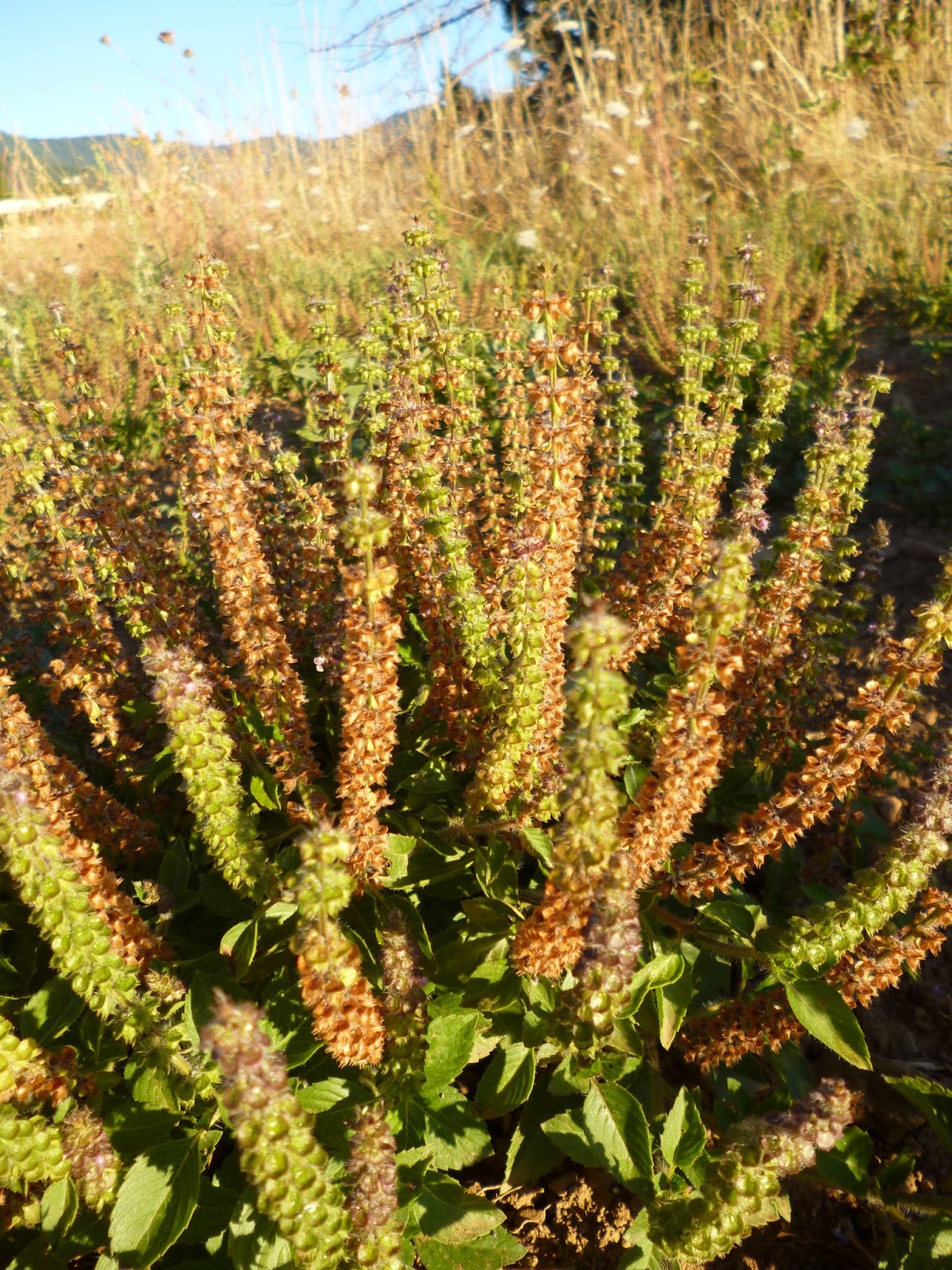
 tulsi:


lettuce drying in the barn:


Ukranian tomato:


processing chimayo peppers:


black corn:


Food crops (including tomatoes & watermelon, for humans and other animals)

cherry tomatoes:


bulk tomatoes:


watermelons:


Wylie eating watermelon:
 

chickens eating watermelon:


Farm Tours Part 2


It’s time for another installment of Rogue Farm Corps farm tours.  I’ve been enjoying these farm tours and the topics discussed by the farmers.

Animal Husbandry & Dairy @ By George Farm
After having experience working in restaurants and interning on other farms in the Rogue Valley, Tyson and Johnny decided to start their own farming venture.  They plan to focus on rotationally grazed animals and currently have a raw milk herdshare as well as many laying chickens.  Raw milk cheese will soon become a sizable component of the business as well.  It was neat to learn about how animals can be used for a healthy whole-farm system.  I also stayed to watch some of the evening milking of the cows and goat in order to learn the basics of milking.

a chicken pen for rotational grazing

eclectic chickens

milking time


Rise Up!/Full Bloom
Full Bloom is an intentional community in the Little Applegate Valley started by a group of people who met when they were apprentices at the Zen Center in Marin, California.  The community owns land that they garden and farm on.  As an important income source, Full Bloom also runs Rise Up! Bakery, an artisan bread business that focuses on using organic and local flours (they make very tasty bread).  Some members of the Full Bloom community have years of experience in collective living and had some useful advice on what makes communities successful.


Medium-Scale Production & Post-Harvest Handling @ Blue Fox Farm
Blue Fox Farmhas over 30 acres of land.  They keep at least 15 acres of that in production at one time and focus on building the soil on the rest of the land.  While Blue Fox started their business by selling at farmers markets, to restaurants, and through a CSA, after having kids they switched to a different system.  They now sell the majority of their produce as wholesale to local food coops and to Organically Grown (a regional organic produce distributor).  Because of the move towards wholesale operation, it is important for Blue Fox to have their GAP (Good Agricultural Practices) certification, which involves having special procedures in harvest and post-harvest handling to mitigate food borne pathogens.  Learning about their post-harvest handling procedures reminded me of my work last summer with Adelante Mujeres, where I helped construct and harvest and post-harvest handling guide for La Esperanza Distributor.

greenhouse peppers

wash & pack station

extra large salad spinners


Apple Orchards @ Thompson Creek Organics
This orchard is run by a couple that had little agricultural experience prior to buying the property (which came with an orchard), and now they run a successful agricultural business!  Thompson Creek has 7.5 acres of apple trees of many varieties.  Over time, they have grafted new varieties onto existing trees that have varying ripening times, taste, and pest/disease resistance.  In addition to selling fresh apples at markets and to independent grocers and cooperatives, Thompson Creek also sells apple cider.  They’re now starting to move into the realm of hard cider, a good value-added product.

touring the fields

apple scab (a common fungus problem)

an extra big cider press


Medicinal Herbs @ Herb Pharm
Herb Pharm was founded in 1979 and is now a relatively well-known liquid herbal extract company.  They have a 25 acre farm in Williams that supplies the majority of the herbs needed for the tinctures, which are made just down the road.  Other herbs are purchased from local farms, and some herbs that do not grow in the southern Oregon climate and must be sourced from other locations around the world.  The naturally-occurring medicinal properties in herbs make them a potentially high-value crop and they can also be farmed in sustainable ways. 

an herb pharm tincture


As we start into the final stretch of the season, there are a few remaining classes including Business 101, Permaculture & Biodynamics, and Seeds (at DBF!).

Sunday, August 25, 2013

CSAs: The Siskiyou Sustainable Cooperative


I wrote an introductory post about CSAs which you can view at this link.  Now that I have had a chance to shadow the Siskiyou Sustainable Cooperative (SSC), I’d like to share a little bit about this unique CSA.

The SSC was formed in 2002 by a group of southern Oregon farmers who wanted to collectively market produce and potentially provide other services for farmers and their families.  Over time, the farms involved in the SSC have changed and the CSA has become the main operation of the SSC.  Today, there are nine farms plus a handful of specialty producers that together grow delicious food for a 180 member CSA.  Maud and Tom Powell of Wolf Gulch Farm coordinate the whole operation so that the farmers and members can be happy each week.

Coordinating such an operation is not a simple venture.  While the CSA itself delivers for less than ½ of the year, the SSC is active year-round.  The farmers meet throughout the winter to plan what crops they will grow for the CSA at what time of year.  In other words, specific farms will commit to growing the early season lettuce, mid-season lettuce, or late season lettuce, and so on.  They will also decide on appropriate prices for each item of produce.

In the early spring, advertising for CSA membership becomes important.  Last year, the SSC received a large USDA grant and a lot of that money was used for marketing: a new website, posters, brochures, and other forms of advertising.  According to Maud (CSA coordinator), social media and word of mouth seem to be the most successful ways to recruit new members.  

an SSC brochure

People that choose to purchase a membership have three share options: a large share ($700 for the season), a small share ($500), or a mini share ($300).  A large share will feed 3-5 adults for the week, while a mini share will feed one person for the week  Members can also pay extra to order specialty items to be delivered weekly, bi-weekly, or monthly in their boxes: fresh chevre from Mama Terra Microcreamery, bread from Rise Up! Bakery, grain from Dunbar Farm, eggs from By George Farm, beef from L & R Farm, and flower bouquets from Sun Spirit Farm (see farm profiles on SSC's website).  This year, the SSC has also included an online webstore that has other additional produce items that members can select each week to be added to their box.  While these specialty and extra items require extra work for the SSC, they have been popular and it is important to the SSC to provide members with extra options.

After a spring of signing up members and planting crops, it is time for the CSA deliveries to begin.   This year the first delivery was June 13th.  Each week a lot of works goes in by Maud, Tom, and the farmers to make sure that all boxes are filled by delivery time.  A typical week includes some of the following activities:

Tuesday:
- Tom calls the farmers to see what produce they have available.  He plans what is going to go into the large, small, and mini boxes, and then calls each farmer back to tell them specifically what he wants them to harvest.
- Maud prints out a variety of important spreadsheets and checklists for the week using Farmigo, a CSA management program.

Wednesday: 
- Farmers harvest their produce. 
- Tom inventories the ready-to-fill CSA boxes and puts them in the truck.
- Maud sends a reminder email to all of the members, which includes a list of items that they will be receiving in their box this week.

Thursday morning:
- Pack out!  Farmers bring their produce to L & R Farm, where all of the boxes are filled with food, item-by-item.  Maud and Tom coordinate the entire process and ensure all of the specialty orders are also placed in the appropriate boxes.  They make it seem easy!  Once the boxes have been filled, they are loaded into the truck in order of drop point and are ready for delivery.

pack out action

Thursday post pack out:
- The boxes are delivered.  There are 12 drop points where members can pick up their produce, located at homes and businesses in southern Oregon towns.  Tom uses the big CSA truck to deliver to nine of the twelve locations, while others help with some of the other sites that are in other directions.  At each site, the boxes will be unloaded and organized by share size (each box is also labeled with the member’s last name).  Tom makes sure that all of the boxes for that drop point have been unloaded and retrieves the empty boxes from last week’s delivery.  Once all of the deliveries are made, the truck goes back to Wolf Gulch Farm where the empty boxes are unloaded and cleaned for next week.
- Also on Thursday, Maud sends out recipe ideas to members for produce they may be unfamiliar with.  She also uploads a video to YouTube that includes a farmer explaining some of the produce items in the box this week.  Here's a link to last week's video.

- Happy members pick up their boxes.  

Tom inventorying boxes at a drop point Medford

And then the weekly cycle begins again. 


an early season box

I mentioned how CSAs can present unique opportunities for being committed to social justice in my first post.  Not only does the SSC provide income for sustainable farmer’s livelihoods, but it also works to provide produce to a range of constituents.  The SSC accepts Oregon Trail Cards (Oregon’s SNAP) and a decent number of CSA members make use of this option.  Additionally, an anonymous donor provides funding each year for the SSC to provide $10,000 worth of produce to senior citizens in the Medford area through ACCESS, a local food and housing assistance organization.  These produce donations come in weekly installments during the height of the growing season (aka, right now) for a period of about 10 weeks.

The normal CSA season ends after 15 weeks of deliveries.  However, members have the option of purchasing a post-season share that provides deliveries until Thanksgiving.  After that, farmers usually take a break over the winter.  However, some farms in the SSC (Wolf Gulch and Barking Moon) have their own winter CSAs, which means that consumers can get fresh local produce year-round if they desire.

Thanks for reading, and thanks to Maud and Tom for letting me shadow them at their farm, pack out, and CSA delivery.

Sunday, August 18, 2013

A trip to Seattle for a community gardening conference


Last weekend I took my first few days off from my internship to attend the American Community Gardening Association’s annual conference, which this year was at the University of Washington in Seattle.  The ACGA is an organization (headquarted in Columbus, Ohio) that supports and provides resources for the community gardening movement throughout the nation.  What’s really neat is that it focuses heavily on building healthy communities and providing garden-fresh produce for everyone, not just those that can afford it.  Once again, I was reminded that gardening is so much more about people than it is about plants.

At the conference I attended sessions led by organizations that are working to improve community food security through a variety of programs.  Here are some of the organizations that I learned more about. 

In the Seattle area:
  • The Muckleshoot Food Sovereignty Project works is founded on the principle that each native community has a right to definite its own food system and de-colonize its diet.  The project provides a cooking & advocacy training program for Muckleshoot chefs, an Honoring the Gift of Food class at NW Indian College, and has installed native plant gardens in schools.
  • Lettuce Link, a program of Solid Ground, works with local gardens and orchards in the Seattle area to deliver fresh food to the food bank and other community programs.  As another Solid Ground project, Marra Farm on the west side of Seattle houses a Lettuce Link patch, a children's garden, and a P-Patch community garden.  They are able to donate 22,000 pounds of food each year from 4.5 acres and in addition local immigrant communities are able to grow food for themselves.  This property has been farmland since the 19th century and is one of Seattle’s two remaining historical farms.
  • Good Cheer Food Bank on Whidbey Island has an on-site garden that provides fresh food throughout the summer to food bank clients.  During the off-season, the food bank partners with local farms so that food bank clients have access to fresh, local, organic produce all year long in its Fresh Food on the Table program.  They also host cooking and gardening classes.
  • South Seattle’s South Park Fresh Starts distributes plant starts at the food bank- a win-win where the food bank provides another outlet for fresh produce and the client can grow food for themselves and for their neighbors.  The program has also begun helping community members start community gardens that focus on being creative with used materials and vacant space.

food bank lettuce at a community garden in Seattle
Outside of Seattle:

  • Randall’s Island Park Alliance’s urban farm is an educational, non-profit, one acre farm located between Harlem, the South Bronx, and Queens in New York City.  They teach children and adults about fruits, vegetables, chickens, and rice cultivation and consumption.
  • The Sustainable Food Center in Austin, Texas has developed an integrated approach to creating a healthy food system.  The program has community focal sites (usually schools) where community members get together to create a Wellness Team that can help implement a variety of programs.  These programs include the Happy Kitchen/Cocina Alegre cooking class, farm-to-school cafeterias, and giveaways of seeds and compost.  The organization also operates four farmers markets in Austin that provide a $20 match program for SNAP and WIC.
  • The Oregon Food Bank offers the Seed to Supper gardening course, a place for adults to learn basic gardening skills for free.  The class is taught by volunteers, and is one of OFB’s attempts to move beyond emergency food to more sustainable solutions.

OFB's Seed-to-Supper course guide

Seattle is an excellent place to host a conference about community gardening.  The city’s Department of Neighborhoods has supported community gardening for decades with its P-Patch program.  P-Patches are community gardens that exist throughout the city and are open to anyone, but especially focus on providing a gardening space for resource-limited communities like immigrants, elderly, and low-income folks.  In these plots gardeners can grow food for themselves and actively donate food to the food bank through programs like Lettuce Link.  To date, there are almost 90 P-Patches in the city that vary in size and age, totaling around 3000 individual plots.  In addition, there are a wide variety of other urban agriculture projects in the city such as food forests and orchards, market farms, therapy gardens, and educational gardens.


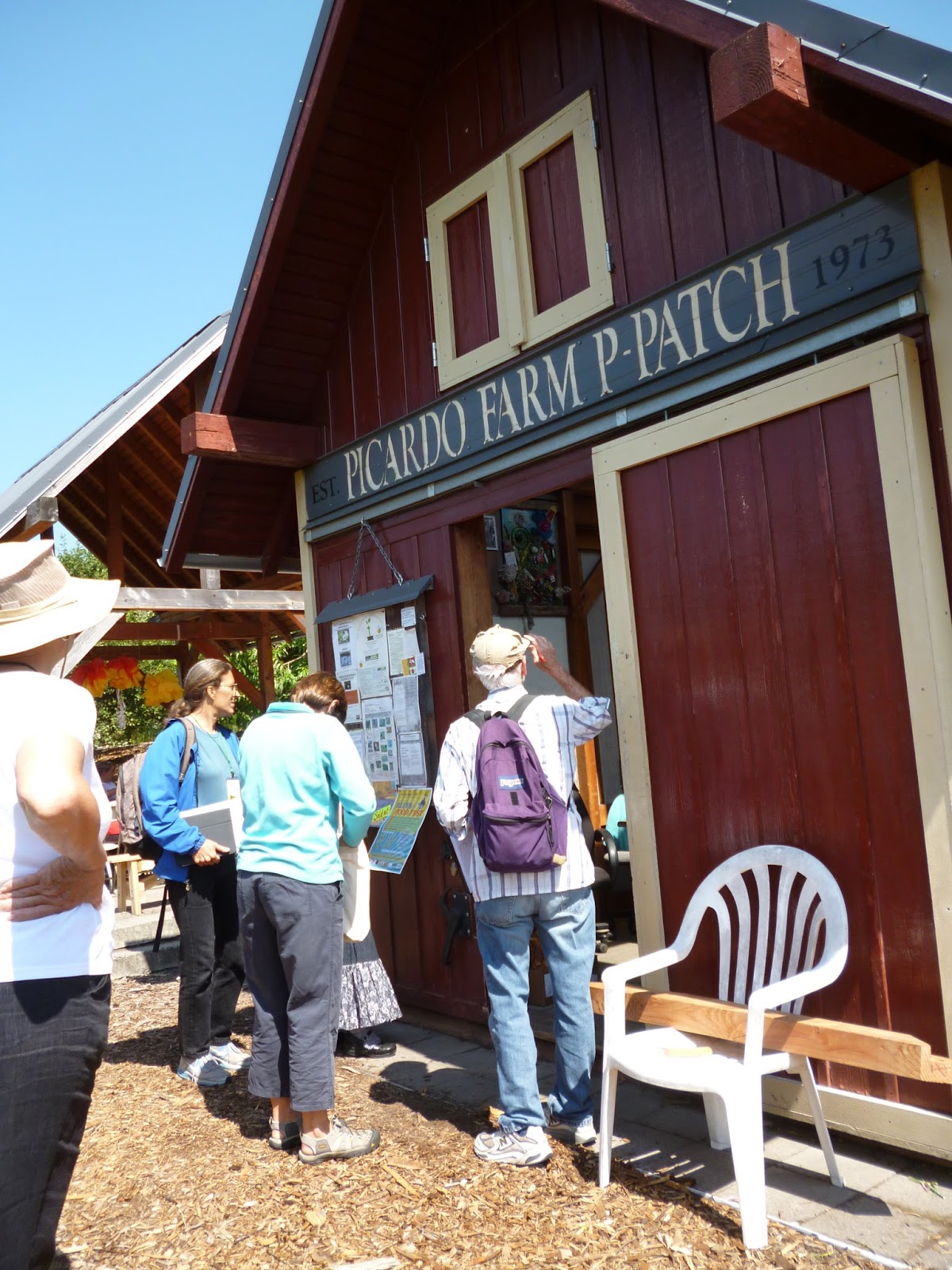
As part of the conference I also got to tour some of Seattle’s historic community gardens.  Picardo Farm P-Patch was the city’s first P-Patch, and today houses over 300 plots on 2.3 acres.  They also have a children’s garden, food bank garden, mushrooms, bamboo, and bees.  Interbay and Eastlake are equally booming P-Patches in other parts of the city.  

Picardo Farm P-Patch gardens

Picardo's tool shed

Eastlake's terraced garden plots

I also visited Danny Woo in the International District- not a P-Patch but still a community garden, coordinated by a local CDA.  Danny Woo has nearly 100 plots on 1.5 acres for elderly community members who live in affordable housing, most of which are immigrants from Asia.

One gardener shows us her plot at Danny Woo Community Garden

chickens at Danny Woo

As you might see from the long list of organizations, projects, and gardens, I got to learn about and see an extensive number of community-based projects that are working on improving local food systems.  I was energized by the work to build just communities in urban settings and I see myself fitting in somewhere in this type of work.  Next year, the ACGA conference will be in Chicago, another city full of awesome community gardens.  Maybe I’ll make it out there for a visit.

Sunday, August 4, 2013

CSAs: the basics + opportunities for social justice


As part of Rogue Farm Corps, each intern is required to do an independent project.  This project is a chance for us to learn more about a specific aspect of agriculture; other than that stipulation the independent project is pretty open for us to decide what we want to do.  When I first started thinking about my project, I really wanted to do something related to my passion of making fresh, organic, culturally-specific produce available to all communities, not just a select few.  Before I could narrow the topic down, however, I began learning more about the Siskiyou Sustainable Cooperative, a CSA of which DBF is a founding member and has successfully operated in the Rogue Valley for a number of years.  I was intrigued by this model of food distribution and decided to learn more about CSAs for my independent project.

“CSA” stands for Community Supported Agriculture and is just one model of agriculture that has become quite popular in the United States’ alternative agriculture and local food movements.  The basic CSA model is as follows: consumers (let’s call them CSA members) pay a sum of money upfront to the farmer in order to receive weekly boxes of produce throughout the growing season.  The money from the CSA members provides the farmer with important upfront funds; the farmer also doesn’t have to worry so much about marketing the produce later in the year (it’s already been sold to the members).  CSA members can experience eating seasonally, eating locally, and eating new foods (typically the member does not decide which veggies are in the weekly box).  They also have the chance to get to know their farmer, either through weekly box pick-ups or by helping out on the farm. 

CSA members receive a weekly box of produce like this one
(from the Sisikiyou Sustainable Cooperative earlier this season).

These shares are nearly ready for delivery.

According to Local Harvest, there are over 4000 CSAs in the US today.  Sizes of CSAs vary.  Some farms provide just a few CSA shares, yet some CSAs have grown to provide over a thousand shares.  Additionally, many variations on the CSA model that I described above have been adopted.  What is amazing is how quickly the CSA movement has spread and evolved- the CSA model didn’t really exist in the United States until the mid 1980s.  

While I took a bit of a divergence from my original goals of studying food access, the world of CSAs is not devoid of people who are working to make good food available to people from all backgrounds.  Yes, CSAs are often criticized for their inability to be inclusive for a number of reasons.  Members normally have to pay a very large sum of money at the start of the season (hundreds of dollars) for produce that costs more than conventional grocery store stuff.  It also requires having time to retrieve the weekly box of produce and to prepare the wide variety of produce that a member might receive in a weekly box.  Such aspects of the CSA model make it a commitment that only people from privileged (white, educated) backgrounds will make.

While CSAs do get criticized often, many CSAs are committed to social justice and have devised programs that target food insecurity.  Thus, CSAs do have the potential to be part the larger movement to make the food system more just and equitable.  For example, some CSAs provide discounted shares for low-income individuals and families.  These can be funded through revolving loan programs, donations from other members, or special grants.  Other farms have tried to make their CSAs more accessible by offering working shares (a share in exchange for farm work) and by accepting food stamps (there is a list of CSAs which accept SNAP throughout Oregon at this website).  Some CSAs also decide to donate shares and excess produce to community-based organizations such as women’s shelters or food banks.  Lastly, some CSAs are actually social enterprises.  Adelante Mujeres, the organization I interned with last summer in Forest Grove, Oregon, is one example- they just started a CSA which provides beginning Latin@ farmers with an additional marketing outlet.  It’s neat to see some projects that are implementing not only temporary but also more sustainable, empowerment-focused solutions to food insecurity.

I’ll be writing more about the Siskiyou Sustainable Cooperative as I shadow various parts of their operation and learn what strengths and challenges they face as a CSA here in the Rogue Valley.

Saturday, August 3, 2013

Making a value-added product: from calendula flowers to massage oil

In our current economic system, it’s really hard to make a living as a farmer.  The majority of farmers (especially small farmers) rely on other forms of off-farm income, such as a "day job" or a spouse’s job.  Another way that farmers can make more money off of their crops is through creating value-added products.  Value-added products are essentially what they sound like: you take a product that you have and process it in some way that makes it worth more money.  Some examples of value-added products are cheese (from milk) and salsa (from tomatoes and other veggies).  The cheese and the salsa can be sold for a lot more than their raw materials.

Dancing Bear Farm sells mainly vegetables and seeds.  However, we do make a few value-added products.  This week I learned more about how DBF makes its hand and massage oil.

calendula flowers

The oil’s main ingredient is olive oil that has been infused with calendula flowers that have been grown on the farm.  You may remember some photos from earlier in my internship of us harvesting calendula flowers to be dried.  These dried calendula flowers are put in olive oil, where they are allowed to infuse for a few weeks.  Then, the oil is strained and cleaned (a process which takes an additional couple of weeks).

These dried flowers are ready to be put in oil.

Finished calendula oil is very yellow.

The finished calendula oil becomes massage oil simply by adding some vitamin E and essential oil (rosemary, ylang ylang, patchouli, and lavender).  The small amounts of the additional oils that we add come from a Portland business called the Essential Oil Company

We pour the calendula oil into small containers.

We add essential oils to the calendula oil for fragrance.

So, there you have it: turning calendula flowers into a value-added product of massage oil.

Here is some of the completed product.