Tuesday, January 17, 2012

A short reflection on Thailand


I have been in the States for less than a week, and thus my experience in Thailand is still a very large part of my daily thoughts (heck, my experience in India is still a very large part of my daily thoughts).  Processing experiences abroad seems to take a long time and I would not be surprised if it was a lifelong process.  Thus, I do believe that my reflections on my travels in Thailand will develop and change over time.  Here are some things I have been thinking about in the past few days. 

1.  I learned a lot about ways to approach life changes, especially death, in ways other than sadness or anger.  I heard many Thai people talk about taking life day by day, without regretting the past or worrying about the future.  I also saw that when someone died, people did not just completely shut down with mourning.  A funeral was not just a place to cry but also to celebrate and enjoy the company of a community.  I think that Thai people had a nice balance of emotions and were much more accepting of life changes.  They seemed to “go with the flow” much better than we do here in the States, where we will stop at nothing to retain our American lifestyle of valuing youth and high consumption.

2. This second point relates to the emphasis of taking life day by day without regretting or worrying.  I think it also has to do a lot with different perception of time: the idea of schedules, due dates, and plans seem are not as rigid in the Thailand that I experienced.  Thailand seemed like a country where stress did not exist.  I’m not sure if this was me oversimplifying (it probably was), but at least the notion of anxiety was nowhere near as prevalent as it is in the American society that I inhabit.  Since I have returned I have tried to live without a constant feeling of avoiding stress, being stressed, working in a hurry, or focusing on deadlines.  My question is this: Can I live without a concept of stress at The College of Wooster, an environment which I have always perceived as very high-stress because of how hard I expect myself to work?  Some people think that at least a little bit of stress can be very helpful in achieving one’s goals.  So far, I am feeling very good with my “no stress” attitude and I seem to be doing alright with just taking things as they come.  Will it survive?

3. Can the way we approach spirituality and religion in the US be changed?  I have seen how intertwined and fluid spiritual life is with the rest of society in other nations and think that this can really enhance one’s quality of life.  It may even, if practiced correctly, lead to a more ethical life.  (However, as I have seen in Thailand, religion can often be used as a form of oppression.)  In Thailand, I really appreciated how spirituality, faith, religion, etc. did not need to be put into boxes like it does in the United States.  It bothers me here how much emphasis we put on separating church from state (even if that doesn’t really exist), how we judge people based upon their religion, and how we say that people who aren’t part of a specific religion are not religious people.  Why is it so important that we are a Christian or a Muslim or a Jew or an Atheist?  And why is it so important that we often seem to keep our own faith practices hidden or separate?  After all, we are all human beings.  Even if we practice different forms of spirituality, we could still at least talk about them or use them for the common good.  I saw some examples of these practices in Thailand, such as in HIV/AIDS work.  I also saw the acceptance of many forms of spiritual practice in Doi Lan, the Li Su village.

4.  Thailand appeared to be a very hierarchical country, with so much emphasis placed on the king and also one’s own personal status.  Despite how Thailand is often portrayed in international media, it did not seem like any more of an unstable nation than any other country I have visited or lived in.  I learn a lot in my sustainability classes about how development is best when it is a grassroots, bottom-up initiative.  So what about the case of Thailand, which appears on the surface at least to be the exact opposite?  (Note that I am someone who is a big advocate for bottom-up development, and even I am asking this question.  Perhaps everything is not so black and white.)

It’s still hard for me to write even these comments down because I feel unsure of what I write about.  In the end I leave with more questions that I started with.  However, I am very thankful to have had this trip.  I am especially very grateful for getting to meet and learn from many unique people while in Thailand.  My weekly Asian and Asian American Feminist Theology course starts tomorrow night and so I get to continue questioning.  Thus, I hope to continue to write follow-up posts on topics such as those that I touched on above.  (Also, a sneak peak at my next “abroad” experience: driving from Tucson, Arizona to Nogales, Mexico with a BorderLinks educational experience in March.)

Here's to feeling stress-free in Thailand and the US.  (Hopefully that also goes for my Li Su cat friend.)

Sunday, January 15, 2012

Back in the States

Dear friends,

I am back in the States now and will drive from Allen Park, MI to Wooster, OH in about 12 hours.  I haven't been able to muster up a reflection post yet, but hopefully I can have one in the coming week.  In the meantime here are some photos I would like to share with you.

International Women's Partnership for Peace and Justice visit
Anna and Liz's blog post on the visit
IWP's website

Soybean fields at IWP.  Just like Ohio, right?

Ginger, our IWP host, was using these bricks to build her new home.

Visit to Doi Lan, a LiSu village
The LiSu are an ethnic minority of northern Thailand and Burma.  We stayed in a village of about 100 households, called Doi Lan, for 3 nights at the end of our stay in Thailand.
Nancy and Abby's blog post about our last full day in Doi Lan


My host family was drying beans outside when we arrived.

After Thai government programs to eradicate opium production, coffee has become a main crop for Doi Lan.

Doi Lan seemed to have the best food in all of Thailand.  This is sticky rice, similar to mochi, toasted with cinnamon and sugar.

Eggs, tomatoes, cilantro, squash, greens, rice.

One of our furry and flea-filled friends.

The largest livestock which the people in Doi Lan raise are pigs.

Celeste, Erin, and cat in front of our host family's house and kitchen.

Some more of our furry friends.

Coffee tree starts.

The school garden.

A view of the hills.  Much of the area has been deforested.

Can you tell that Celeste, Erin, and I spent most of our time playing with animals?

A visit to Doi Chaang's luxury coffee production operation.

The first rice and pig slaughter ceremony.

Our host parents (Asapa and Alima) weighing and selling their beans on our last morning in the village.


Last Day in Bangkok

The Erawan Museum's 5-story 3-headed elephant.

At the top of the elephant structure is a room filled with centuries-old buddha figures from various kingdoms in Thailand.

The Erawan Museum also had beautiful flowers spread across their grounds.

Too bad these don't grow as well in the Midwest.

We used the skytrain as a nice alternative to Bangkok's road traffic.


Friday, January 6, 2012

Doi Suthep, Chiang Mai

Yesterday our class visited Doi Suthep, a large mountain in Chiang Mai which has a famous wat (temple) at the top.

Heading up the mountain (there's Ken in front of us).

There are 3 objects often involved in making an offering: 1. Two candles, which represent the teachings of the Buddha (both what to do, and what not to do).  2. Three incense sticks, representing the 3 qualities of Buddha: purified, wise, and full of loving kindness.  3. One lotus flower, representing well-practised monks that show that no matter who you are, you can become a spiritually beautiful person.

These bells surround the wat and anyone can ring them (such as Erin and Anna).  They can be very popular for children, or children at heart.

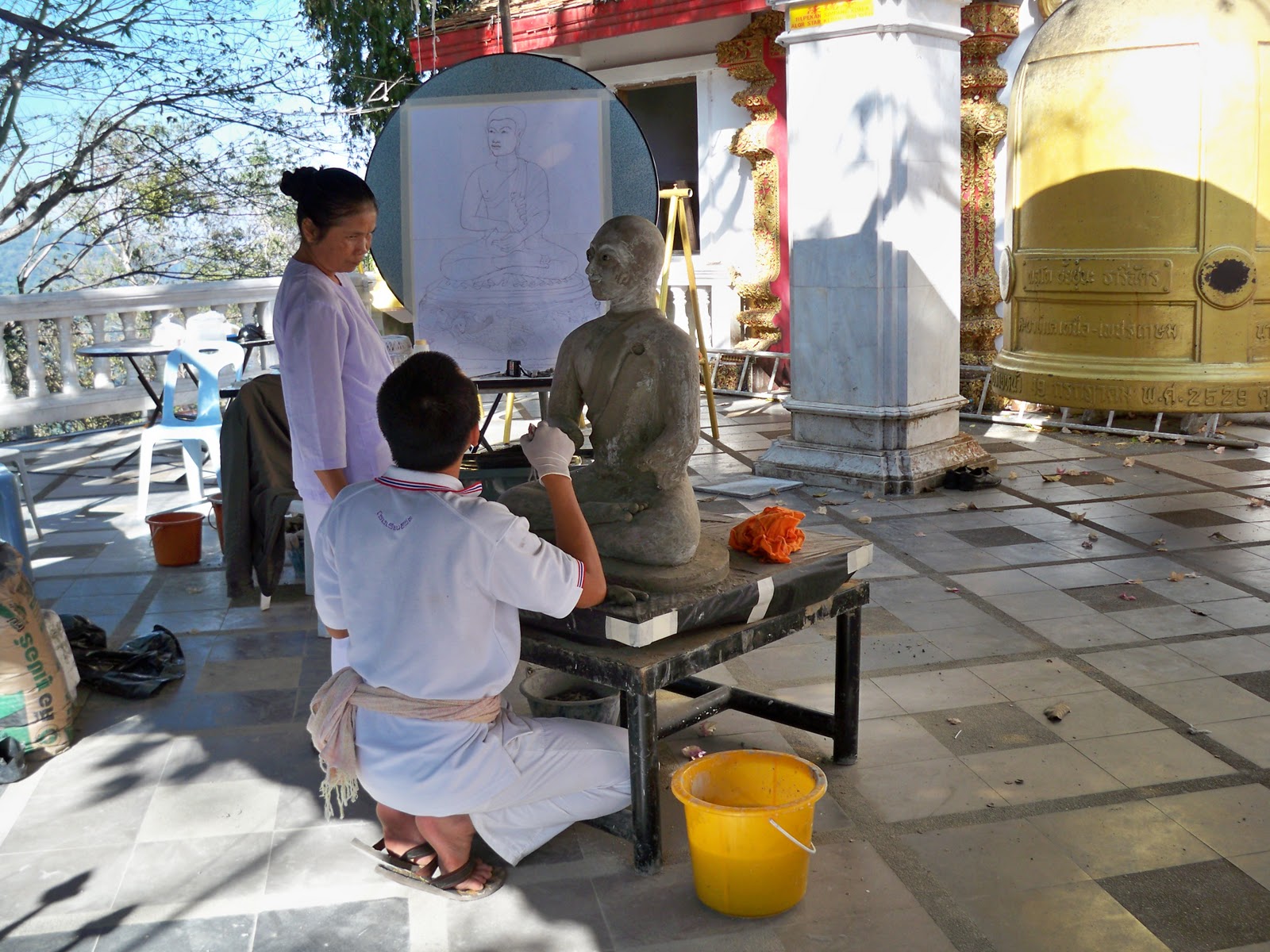
Here is a man creating a statue of a famous monk.  You can see the drawing of the monk in the background.

A view of Chiang Mai from the top of the mountain.


A mythical creature, taken from Hinduism, which connects water and sky because of its physical features.

The large pagoda represents the residence of Buddha.

We saw many Buddha images, each of which represent the image of Buddha according to certain group of people.  The first Buddha image was not constructed until 500 to 700 years after the death of Buddha.  This original image was constructed by Greeks, and then later went from India to Burma to Lanna to Sukhothai (Thailand).

Heading back down the snake-lined stairway to the bottom of the hill.


Tuesday, January 3, 2012

Some photos from Thailand thus far

Wat Arun, Thonburi (across the Chao Phraya River from Bangkok).

Wat Arun.

Wat Pho's reclining buddha, Bangkok.

Chinatown, Bangkok.

Chao Phraya River, Bangkok.

New Year's Eve, Chiang Mai.

Fields in Mae Ta village.

Mae Ta village chicken (the village also had fish, frogs, deer, porcupine, and hogs).

Working the fields.

Nature walk, Mae Ta village.

Don't forget to keep following our trip here: http://woointhailand.blogspot.com/.


Friday, December 30, 2011

Off to Chiang Mai

Dear friends,

After 3 full days in Bangkok our group is heading off to Chiang Mai today at noon.  This is an abbreviated post so I won't say much, but here are some sites I have visited: Wat Arun, Wat Pho, Mountain Temple, Democracy Monument, Vivanmek Mansion, Chinatown, Giant Swing, a wholesale market, and many other markets.  I have also explored 3 different forms of public transportation: the bus, the sky train, and the river bus.

My biggest reaction so far is how differently I am treated when traveling around Bangkok with two other Thai women (days 1 and 2) and when I am traveling with 16 other Americans (day 3).  In the first case, I think people tend to assume I am Thai; in the second case, it is obvious that I am in a group of foreigners.  Even the process of getting in at temples for a Thai and for a foreigner is completely different- foreigners usually have to pay and Thai people just seem to walk in.  We'll see how it is in Chiang Mai.

Happy New Year's Eve and Happy New Year tomorrow.  Chiang Mai is supposed to be a good place for New Year's Eve; hopefully I can stay up late enough to partake in the festivities.  Then tomorrow we'll head out to Mae Ta, a village which recently converted to organic farming.

-ET

PS: Sorry the photos are absent.  I probably will not be able to post any until I return to the States on the 13th of January.

Monday, December 26, 2011

Guest Blogger Colin: Look to See

I asked my brother Colin, a senior at Riverdale High School, to reflect on his experience in India, so here it is for you to read.  Can you tell that we are similar?  Enjoy, and thank you Colin for your reflections.


Bridges to India students 2011.  Colin is second from left.

From November 18th to December 10th I was on a trip to India with 12 other students, 1 parent, and 1 teacher from Riverdale High School. This trip, known as “Bridges to India”, has been occurring for the past 8 years. Before the trip we had spent over a year preparing and gathering donations in order to fulfill our goal of $40,000. The money all goes to the whole reason for the trip: supporting Hope Charities. Hope Charities is non-profit that gives aid to poor areas of people in Kerala, India. So far, Hope Charities has created a free clinic, tutoring school, women's sewing/empowerment center, a well for a impoverished community, a house for a poor family, and now, a new Pre-K school for local children. On our trip we visited major sites such as the Taj Mahal, we went to schools and talked with kids our age, and we also painted the new Pre-K school. Before we left on our trip, Daisy Kuchinad, the founder of Hope Charities, gave us one bit of advice: “Look to see”.

From when I landed to when I left, India never failed to be engrossing and surprising.

The traffic is insane, and when I say insane, I mean insane. Auto rickshaws drivers don't seem to understand the idea that the oncoming lane is for vehicles going the other way. Drivers swerve, drive perpendicular to traffic as traffic police who have given up trying to control the chaos stand by. People will cut off others and get into space that looked too small to fit their car (sometimes drivers do try to get into space which really is too small, the scuff marks on the sides of everyone's car is proof of that). Not only is the traffic hectic, but the horns are like an orchestra of the worst musicians ever. Honks surrounded me as soon as I stepped out of the airport in Delhi and they never ceased. Some horns are a standard beep, but in a place like India, being standard is way too boring. So, there are some horns that boom, some that squawk, some that scream, some that yodel, some that sound like “alalalalalalala,” you get the picture. Some cars even have multiple horns that drivers can switch between.

Indian people are by far the most hospitable, friendly, and open people I have ever met. In every school, the students would swarm us, asking for handshakes, our names, pictures, and even autographs. (Would students at a high school in the United States swarm some Indian students like this? Probably not.) The students' hospitality made our integration into their community so much easier. We didn't have to force ourselves in and hope for the best, the students wanted us to join them and they wanted to learn from us as much as they could. Just walking by on the street families will run out to their front porch and watch and wave. At first they may have a slight scowl as they try to figure out why 14 non-Indians are walking down their street, but as soon as they got a wave from us, we got one back and the scowl changed into a full face smile. As we visited houses in the poorer communities, people would sometimes give us gifts. Once the families saw us walking down to their house, they would run over to the nearest fruit tree and grab handfuls of some fruit that you've never seen nor heard of and then hand us every single one. All the while, they are smiling and laughing, clearly happy to give us the fruit.

When economists and politicians say that India will take over the world from the U.S., they mean it. India is constantly moving and evolving. Construction is never ending and people are always working. Neighborhoods and giant business buildings are shooting up everywhere. Outsiders always think of India as a place full of poverty, and while it is, India is also a place full of commerce. Without getting into the numbers, the Indian economy is booming. Now, I don't necessarily care what this means for GDP or how much I can gain from this, I care more about how this could change the way the world is run. The U.S. in terms of spirituality, poor population, population in general, and work ethic is dwarfed by India. Perhaps having India “take over the world” may prove to be a very positive thing. Just like with U.S. culture spreading across the globe, perhaps Indian culture will spread as well. Maybe one day, Americans will be living their lives with a little bit of an Indian attitude. Maybe they will think a little more about the problems that affect the poor, maybe they will be more in touch with their spiritual side, maybe they will think about how the world is not all about them and that there are 7 billion other humans sharing the world with them, and maybe Americans will have to work as hard (not necessarily at their profession) as many other people do across the globe right now.

Living in the U.S., even the most well-educated and globally aware people are still sheltered by the luxuries of American society. Moving out and exploring other countries is completely necessary in order to see how the majority of people actually live their lives. If every American traveled to another country and “looked to see” (and not to a resort town full of people exactly like us), they would begin to understand that the U.S. is not normal at all, but the exception. They might feel grateful to live in the U.S. and they might lose the complacency that all Americans have towards the problems of our world. They might see that American society is in some ways great, but in other ways completely unrealistic and wrong. I know that India did that to me.

Hope Charities, where you can find information and donate: http://hopecharities.org/

Bridges to India 2011 blog: http://riverdaletoindia2011.wordpress.com/

P.S. Be on the lookout in the next few days as my Asian and Asian American Feminist Theology class begins posting about our Thailand trip at http://woointhailand.blogspot.com/.  If I have computer access you'll also find some posts or photos on my own blog.  Thanks for reading.

Thursday, December 22, 2011

Thailand and India

Dear friends,

Hello again, this time from the sunny Portland, Oregon.  I'm here for a week before I make my way to the Land of Smiles, aka Thailand, for 3 weeks.  This is part of a field experience for an Asian and Asian American Feminist Theology course I will be taking at Wooster this spring.  Please follow our class' blog here, as I will not be bringing a laptop to post on my own frequently.  I will, however, provide some sort of reflection and photos on this blog once I return in January.

I will start and end my journey in Bangkok but will spend most of my time in Chiang Mai.

We have got quite the full itinerary for our trip.  We'll be learning about the Thai culture (in Bangkok, Chiang Mai, Mae Ta, and Doi Lan), visiting with religious and feminist organizations, and also learning about work to eradicate social injustices by various groups in the country.  For me, I see this experience as a way for many of my interests to come together: travel, my identity as half-Japanese growing up in America, social change, and cross-cultural interaction.  I'm also looking forward to all things agriculture: we will be visiting Mae Ta, a village in northern Thailand which recently converted to organic farming.  And, as a special bonus I will get to meet up with Teya, my family's former exchange student who lived with us in 2008-2009!

Thailand's not all about the Grand Palace, although it is definitely one of Bangkok's amazing architectural features.

On another note, I have done little to forget about my experiences this past summer with Global Social Entrepreneurship in India.  I participated in recruiting the team for GSE 2012 and out of a large applicant pool 12 amazing students were selected.  We even made it into the Huffington Post.

My brother also was lucky enough to travel to India for 3 weeks just a few weeks ago, doing some educational tours and also volunteer work in Kerala (see his trip's blog here).  I will post some of his reflections before I leave for Thailand, so be on the lookout.  In the meantime, here's some sneak peek photos.
 
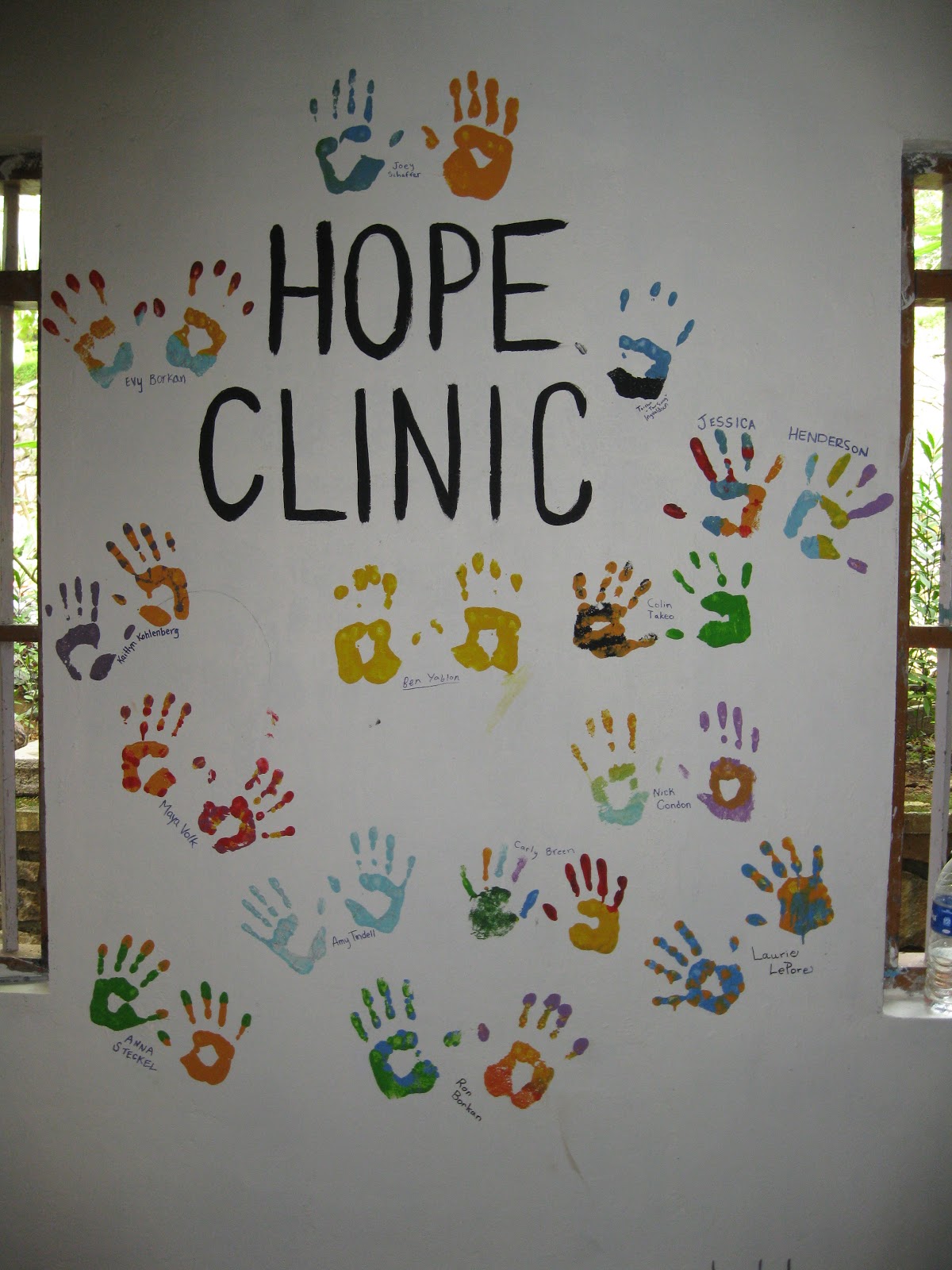
Part of the time Colin spent in India was devoted to making a mural at Hope Clinic.

The yellow submarine credit goes to Colin.

A beautiful Kerala sunset, taken from a Kerala backwaters boat ride.